Showing posts with label reading. Show all posts
Sunday, March 18, 2012
Book Review: The Terror by Simmons
The Terror by Dan Simmons
My rating: 4 of 5 stars
I read The Terror as part of a group read at the Science Fiction & Fantasy Book Club at GoodReads during the month of February. I participated in the discussion, as did many others. To review those threads, please follow this link.
I started reading this the evening of February 13th, with snowfall predicted to commence after midnight. I sat shivering at the kitchen table while I read the first few chapters, even though the furnace kept my house a toasty 78 degrees Fahrenheit. I even dug out a blanket to put on the bed before I went to sleep (still shivering). Brrrr..... Great writing by Dan Simmons, atmospherically speaking.
And I restrained my insatiable desire to research the quest for the Northwest Passage and specifically the final voyage of the HMS Terror until after I finished reading the novel. Simmons kept me riveted until the last few chapters, when he decided to take an extreme detour into arctic supernatural spirituality that left me, well, cold.
Still, a great read by an outstanding author. I recommend lots of warm tea or cocoa and abstinence from long pork.
View all my reviews
Book Review: Archangel by Shinn
My rating: 4 of 5 stars
Beyond Reality February 2012 Science Fiction Selection
The protagonist, Rachel, grabbed me immediately. Not only was she a superb vocalist, she reminded me in so many ways of my own daughter, also named Rachelle, and who is also a superb vocalist (mezzo soprano, though, instead of Rachel's coloratura soprano). As soon as I finished the book, I sent a recommendation off to my Rachelle, hoping she'd read it and enjoy it as much as I did.
The religious references intrigued me (and sometimes made me laugh - did anyone else think that the name of Semorrah was a mashed-up condensation of Sodom and Gemorrah?) and the musical elements fascinated me. I play piano, attempt to sing (not as well trained as my daughter, so I gave it up as a lost cause at this point in my life) and I know basic music theory. My husband has years of training (jazz trumpet and guitar), composes music and has perfect relative pitch; all of which he passed on to our daughter.
On the question of whether this novel is science fiction or fantasy, I leaned towards the former early on. Once introduced to the oracle Josiah in Archangel, I began to believe I was reading a science fiction story (perhaps along the lines of Pern?). But the rest of the novel revealed little beyond that scene with the Oracle. Another clue could also be derived from the 'smallness' of their 'planet' in area and scope.
I interpreted the singing as magical. The story is mostly a romance, which I normally avoid like the plague, but in this case it worked well.
I have not decided yet if I will continue this series. I'll have to research my friends' reviews of it and see if it gets better or if this installment is as good as it gets.
All in all, I really enjoyed Archangel, even if it seemed to be a romance masquerading as a fantasy with hints of science fiction sprinkled throughout.
View all my reviews
Wednesday, January 11, 2012
Winter 2012 Adult Reading Program - Destination: Anywhere
The Kansas City Public Library launched the "Destination: Anywhere" 2012 Adult Winter Reading Program on Monday, January 9, 2012. I plan to participate, although I may not read many (or any) of the suggested books. For the first time since I started following their adult reading programs, I saw non-fiction titles listed in their suggestions. I often need extra motivation to read non-fiction books, as I much prefer to escape to a place that you can't find on any real map. I am most at home on other worlds, in other dimension or in completely imaginary places.
Whether or not I attend any of the events or read any of the books, I look forward to adding to my collection of adult reading program coffee mugs. If you don't live in the Kansas City metropolitan area, an alternative way to participate would be through the library's GoodReads group.
Wednesday, December 21, 2011
Book Review: Ready Player One by Cline
My rating: 4 of 5 stars
I must say Ready Player One easily and quickly became one of my funnest and most memorable reads of 2011. Wade Watts lives in the not too distant dystopian future (mostly in America, but implied world wide aftermath of the post-fossil fuel era). He (and the majority of what's left of humanity) escapes the ravages of poverty and orphanhood through the virtual OASIS reality. When the founder and creator of OASIS dies, he leaves his vast fortune (multi-billions) to whoever can find the egg he hid somewhere in the infinitely vast OASIS universe. Since Halliday obsessed on 80s culture, music, movies and early video games, he expected everyone else to join him. He succeeded posthumously by enshrining the clues to the egg in obscure 80s lore.
Ah, the early geeky memories that flashed before my eyes.
I played Zork and Adventure both. Neither of the two computers I grew up with were listed in the book: a home built Digital Group computer running a very early version of DOS and a Xerox 820 running C/PM. My favorite game (also not mentioned in the book), even more so than Adventure, was one called Nemesis by Supersoft. It's Rogue-like (which I prefer to an all-text based interactive story-type game like Adventure). I yearned to play it again, especially while reading the Second Gate section of Ready Player One, so I found a copy via a Google search. Now to find a C/PM emulator that will run on Windows (or Linus) so I can really revisit the 'good ole days.'
Wargames and Ladyhawke are both two of my favorite movies from the 80s era and the play a significant role in the egg hunt. On the music font, Rush (one of my favorite bands, after Styx and Kansas) provided key elements to the final third of the quest. I almost dug around in my basement for my old dusty Rush albums, but left them to rest in peace. Besides, my husband's band covers older Rush songs so I get a Rush-fix at least once a week.
I am very glad Cline didn't spend much time on the fashions of the day and I ignored most of the other music references (as I was a metal head and refused to listen to pop music). I played nearly all the arcade games mentioned EXCEPT for Tempest.
I wanted more real world information, to learn about the fall of civilization and the consequences of ignoring the ever worsening and appalling conditions rising to destroy what's left of humanity. Some readers have likened Wade Watts to a 'Mary Sue' type character, which is hard to refute since the tale is told in first-person from his point of view. Characterization, aside from Wade, could have been fleshed out more. If a sequel is in the works, I look forward to a deeper look into this world and these characters.
I highly recommend this novel to anyone with a smidgen of geekiness who also happens to be born in the mid-60s or very early 70s (i.e. were you a teenager during the 80s?).
View all my reviews
Novella Review: The Machine Stops by Forster
My rating: 3 of 5 stars
3.5 stars
I found this gem yesterday via Feedbooks public domain short stories listings. I raised my eyebrows when I saw E.M. Forster wrote a science fiction novella (in 1909). I love reading dystopian fiction, provided I space it between less depressing offerings. Forster surprised me with not one dystopian future, but two. His ideas mixed to form a somewhat steampunkish voluntary Matrix benevolent Terminator mashup.
View all my reviews
Sunday, December 4, 2011
Book Review: My Luck Life In and Out of Show Business by Dick Van Dyke
My Lucky Life in and Out of Show Business by Dick Van DykeMy rating: 4 of 5 stars
I barely read any non-fiction (outside of the technical writing found in information technology reference guides) in any given year. When I do branch out away from fiction, I prefer to read a biography, autobiography or memoir, or a history book, usually on a particular brief period.
I breezed through Dick Van Dyke's autobiography quickly, probably because it felt like he sat in my living regaling me with tales from his past in his engaging and witty manner. His charm and good will bubbled out of the pages. Even the troubles and tragedies he confessed only evoked my compassion or caring in my assessment of him.
A couple of excerpts that really struck a chord for me:
I was all about living a kind, righteous, moral, forgiving, and loving life seven-days a week, not just the one day when you went to church. ... And if there's not a higher power, no one's going to be worse for the wear for his or her effort. Was there one way? No, not as far as I could tell -- other than to feel loved, to love back, ... as simple as making sure you spend time helping make life a little better for other people.
(from the Family Values chapter)
A few years ago, I told Esquire magazine that the Buddhists boiled it down to the essentials. They said you need three things in life: something to do, something to love, and something to hope for. The message does not get any clearer. I heard walt Disney, Dr. Martin Luther King Jr., and Carl Reiner all say the same thing in their own way. Hope is life's essential nutrient, and love is what gives life meaning. I think you need somebody to love and take care of, and someone who loves you back. In that sense, I think the New Testament got it right. So did the Beatles. Without love, nothing has any meaning.
(from the Curtain Calls chapter)
When I finished the book, I wanted to give him a big hug, but of course, I'm too far away to do that. So I'll send him a little love for all the laughs and love he's shared unconditionally with me, with all of us really, for some many decades. As long as I've been alive, there's always been a Dick Van Dyke to make me smile.
View all my reviews
Monday, November 21, 2011
Book Review: Maphead by Jennings
For my twenty-first installment in my 'Thirty Days of Thankfulness' I
am grateful for my sense of direction, my spatial awareness and love of
maps and geography. This post will do double duty as it also
masquerades as a book review of Ken Jennings' recently released Maphead.
Maphead: Charting the Wide, Weird World of Geography Wonks
by Ken Jennings
My rating: 4 of 5 stars
(actually more like 3.5 stars, but GoodReads doesn't allow half star ratings)
A quick read, similar in format and informality to Ken's inaugural Brainiac: Adventures in the Curious, Competitive, Compulsive World of Trivia Buffs book. All twelve chapter titles included a cartographic definition together with a quote. For example, the first chapter entitled 'Eccentricity' with the definition 'the deformation of an elliptical map projection' and the Pat Conroy quote 'My wound is geography.'
My favorite chapter falls in the center, halfway from nowhere to somewhere, Chapter 6 'Legend' with a definition of 'an explanatory list of the symbols on a map' and the C.S. Lewis quote 'Most of us, I suppose, have a secret country, but for most of us it is only an imaginary country.' I did a double-take when I read on p. 113 that Brandon Sanderson and Ken Jennings were college roommates. I heartily agree with Brandon's assertion that 'The hallmark of epic fantasy is immersion' and that's why he always includes maps in his books. Brandon goes on to relate to Ken that he 'started to look and make sure a book had a map. That was one of the measures of whether it was going to be a good book or not." When Brandon first read The Lord of the Rings he thought, 'Oho, he [Tolkien] knows what he's doing. A map and an appendix!' Ken states a few paragraphs later that 'Fantasy readers like that abrupt drop into the deep end and the learning curve it takes to keep up' further affirmed by Brandon's confirmation that 'By the end of a big epic fantasy novel, you'll have to become an expert in this world that doesn't exist. It's challenging.'
I
felt affirmed and validated for years of pouring over maps of fictional
non-existent realms. I once thought to recreate the map of Middle Earth
as a tapestry to hang proudly in my living room or library. One of the
first prints I purchased from a newly favorite epic fantasy author, Janny Wurts, was a large format (40x30 inches) map of Athera,
solely because I wanted to be able to trace (without squinting or
resorting to a magnifying glass and the loss of the center of the map to
the no man's land in the binding of the books) the routes of Arithon,
Elaira, Dakar, Lysaer and other characters intrinsic to her Wars of
Light and Shadow epic fantasy series. The first thing I did upon
receiving the next Wheel of Time novel was to skim through for any new
maps interspersed in the chapters and sections. Back in the mid80s, I
purchased both the Atlas of the Land and the The Atlas of Pern by Karen Wynn Fonstad
so I could pour over even more imaginary maps while waiting for the
next Pern or Thomas Covenant novel to be published. But I digress,
tangentially, from the book at hand.
In Chapter 9 'Transit' (definition: 'a piece of surveying equipment used by mapmakers: a theodolite with a reversible telescope'), Ken sparked my interest in road rallies (something I always wanted to do when my husband was a member of the local SCCA). I always excelled at those trick-question instruction test in school, so I might just try Jim Sinclair's annual St. Valentine's Day Massacre (a contest by mail where you travel a circuitous course across American from the Golden Gate Bridge to the Statue of Liberty entirely by maps) next year. That is if I can find a way to sign up; an Internet search came up oddly sparse.
Ken introduced me to 'geocaching' in Chapter 10 'Overedge' (definition: 'the portion of the map that lies outside the neatline border'), which so intrigue me that I grabbed my Nook Color and signed up at Geocaching.com, even though I don't even own a GPS unit (outside of the one in my dumbphone which doesn't have any 'free' software associated with it to assist in finding or placing geocaches).
Overall, I enjoyed the few hours I spent geeking over cartography and geography with Ken Jennings as my tour guide. I learned a few things and I laughed out loud a couple of times. I can't think of a better way to spend a weekend, especially if cold November rain greets you on the other side of the door.
View all my reviews
Maphead: Charting the Wide, Weird World of Geography Wonksby Ken Jennings
My rating: 4 of 5 stars
(actually more like 3.5 stars, but GoodReads doesn't allow half star ratings)
A quick read, similar in format and informality to Ken's inaugural Brainiac: Adventures in the Curious, Competitive, Compulsive World of Trivia Buffs book. All twelve chapter titles included a cartographic definition together with a quote. For example, the first chapter entitled 'Eccentricity' with the definition 'the deformation of an elliptical map projection' and the Pat Conroy quote 'My wound is geography.'
My favorite chapter falls in the center, halfway from nowhere to somewhere, Chapter 6 'Legend' with a definition of 'an explanatory list of the symbols on a map' and the C.S. Lewis quote 'Most of us, I suppose, have a secret country, but for most of us it is only an imaginary country.' I did a double-take when I read on p. 113 that Brandon Sanderson and Ken Jennings were college roommates. I heartily agree with Brandon's assertion that 'The hallmark of epic fantasy is immersion' and that's why he always includes maps in his books. Brandon goes on to relate to Ken that he 'started to look and make sure a book had a map. That was one of the measures of whether it was going to be a good book or not." When Brandon first read The Lord of the Rings he thought, 'Oho, he [Tolkien] knows what he's doing. A map and an appendix!' Ken states a few paragraphs later that 'Fantasy readers like that abrupt drop into the deep end and the learning curve it takes to keep up' further affirmed by Brandon's confirmation that 'By the end of a big epic fantasy novel, you'll have to become an expert in this world that doesn't exist. It's challenging.'
| Pauline Baynes' map poster of Middle-earth published in 1970 by George Allen & Unwin and Ballantine Books. |
In Chapter 9 'Transit' (definition: 'a piece of surveying equipment used by mapmakers: a theodolite with a reversible telescope'), Ken sparked my interest in road rallies (something I always wanted to do when my husband was a member of the local SCCA). I always excelled at those trick-question instruction test in school, so I might just try Jim Sinclair's annual St. Valentine's Day Massacre (a contest by mail where you travel a circuitous course across American from the Golden Gate Bridge to the Statue of Liberty entirely by maps) next year. That is if I can find a way to sign up; an Internet search came up oddly sparse.
Ken introduced me to 'geocaching' in Chapter 10 'Overedge' (definition: 'the portion of the map that lies outside the neatline border'), which so intrigue me that I grabbed my Nook Color and signed up at Geocaching.com, even though I don't even own a GPS unit (outside of the one in my dumbphone which doesn't have any 'free' software associated with it to assist in finding or placing geocaches).
Overall, I enjoyed the few hours I spent geeking over cartography and geography with Ken Jennings as my tour guide. I learned a few things and I laughed out loud a couple of times. I can't think of a better way to spend a weekend, especially if cold November rain greets you on the other side of the door.
View all my reviews
Thursday, November 3, 2011
Reader of the Vast Tomes
As I approached middle school age, I became exposed to other genres, including science fiction and horror. During my early teen years, I couldn't read enough Stephen King. I still consider The Stand to be one of his best novels and a great example of post-apocalyptic fiction. But there came a point when the thrills paled and the terror became predictable. I did an about-face, a complete one-eighty and dived into epic fantasy. I have rarely, if ever, looked back.
Epic Fantasy Tomes
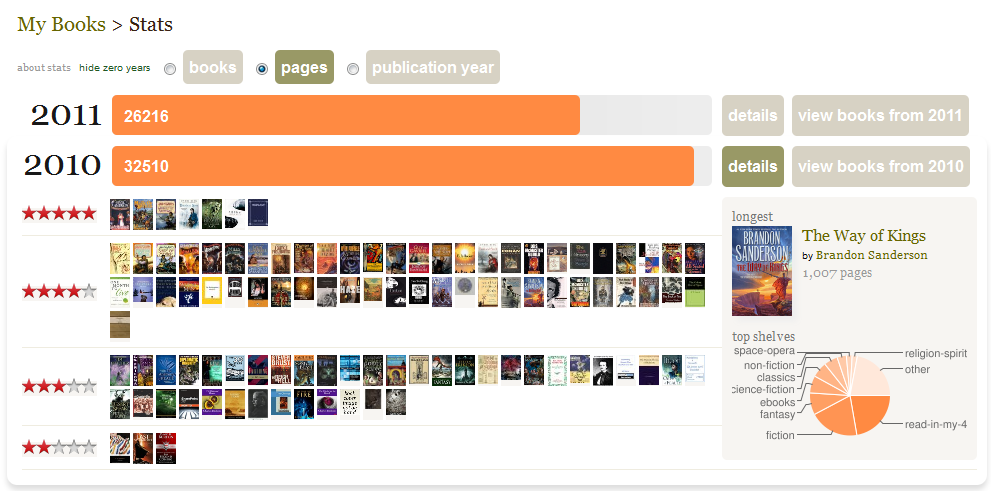
While Janny's latest publication, the very recently released Initiate's Trial, seems long to the casual reader at nearly twice the size of a normal paperback, to me it is a good sized epic fantasy novel. The longest books I've read in the last three years include:
- Jonathan Strange & Mr. Norrell (read in 2009) ~ 1,024 pages
- The Way of Kings (read in 2010) ~ 1,007 pages
- The Wise Man's Fear (read in 2011) ~ 994 pages
Book Clubs
Accessible Authors
As if reading, reviewing and discussing novels wasn't wonderful enough, the real icing on the cake comes from the authors themselves. Unlike in the 80s when I had to write a letter on a manual typewriter and snail mail it to one of my favorite authors with a question (I did this with Barbara Hambly, Piers Anthony and Stephen R. Donaldson - all of whom replied courtesy the self-addressed stamped enveloped I provided them), today's authors write blogs, tweet via Twitter and participate eagerly at GoodReads either as discussion leaders or via dedicated Q&A topics posted for the chosen Book of the Month they wrote. Without their talent, imagination, perseverance and passion, I would have less to read, both in quantity and quality.I highly recommend the following author blogs:
- Whatever by John Scalzi (since 1998)
- L.E. Modessitt, Jr. blog
- Brandon Sanderson's blog
- Patrick Rothfuss's blog
Back to the Future
I still love the heft of a heavy hardcover edition of a treasured classic epic fantasy ... for about five minutes. I may have turned the final page of my last new hardcover. Any future purchases will be made solely to support a favorite author, with the hope of meeting the author and asking for their autograph on the title page. For the lion's share of my reading, and to preserve both my weakening eyesight and the strain on my hands and arms, I will peruse the hundreds of novels and thousands of pages on my Nook Color ereader tablet, which is smart enough to turn off the light and mark my page when I doze off to sleep each night. Thanks again to my husband, for gifting me with this amazing product.Tuesday, October 18, 2011
Book Review: Lighthouse Duology by Berg
I read both of these books back-to-back during the Spring of 2010. They came highly recommended from a respected author-friend, who also suggested I read them together as if they were published as one book. I heartily agree with that suggestion.
Flesh and Spirit by Carol Berg
My rating: 4 of 5 stars
Superb storytelling, twisting plots, puzzles and mysteries, and an apocalyptic convergence made for an excellent and enjoyable read. If it weren't for the press of other book club selections, I would immediately proceed to the second half of this duology, Breath and Bone.
Even though the story is told in the first person, by Valen, it flowed well. I struggled to connect with Valen, a fugitive from his family, constantly on the run and hiding for twelve long years. Magic is strictly registered and contracted among pureblood families and any offspring willful enough to escape the privilege are hunted down relentlessly.
Escaping a battle gone badly, set upon by his own comrade and left to die in a ditch, Valen wakes up in a monastery's infirmary and claims two weeks sanctuary. Thinking he can hide out among the tonsured brothers, he resolves to join their ranks, vowing falsely to obey their Rule for the rest of his days.
Yet all is not prayer, singing, reading, scribing or toiling among these gentle quiet monks. Valen soon finds more than just the porridge is thickening in the unseasonable cold.
Highly recommended for lovers of fantasy, adventure and apocalyptic fiction.
Breath and Bone by Carol Berg
My rating: 5 of 5 stars
4.5 stars
Two worlds, symbiotically connected, only touching each other on the periphery of the senses, plagued by a scourge destroying the human realm which in turn shrinks and blinds the Danae realm. Can a cure be found? Can the world be healed?
But what sacrifice justifies the means? Does Osriel hold the answer in his pact with the 'devil'? Does Silas' goal to purge the world of all classes, races and knowledge, to reboot the world in her egalitarian vision offer the best hope? Or Valen, standing astride both worlds, perceiving the health just beyond his grasp, if only he can overcome his past and the obstacles and enemies in his present.
Beautiful world building, stunning prose, intriguing magic system (in both worlds), satisfyingly twisty plot and exceptionally well drawn, deep characters round out this remarkable conclusion to the Lighthouse series.
I highly recommend both Flesh and Spirit and this novel to all fantasy readers. I suggest they be read together, as one large volume.
View all my reviews
My rating: 4 of 5 stars
Superb storytelling, twisting plots, puzzles and mysteries, and an apocalyptic convergence made for an excellent and enjoyable read. If it weren't for the press of other book club selections, I would immediately proceed to the second half of this duology, Breath and Bone.
Even though the story is told in the first person, by Valen, it flowed well. I struggled to connect with Valen, a fugitive from his family, constantly on the run and hiding for twelve long years. Magic is strictly registered and contracted among pureblood families and any offspring willful enough to escape the privilege are hunted down relentlessly.
Escaping a battle gone badly, set upon by his own comrade and left to die in a ditch, Valen wakes up in a monastery's infirmary and claims two weeks sanctuary. Thinking he can hide out among the tonsured brothers, he resolves to join their ranks, vowing falsely to obey their Rule for the rest of his days.
Yet all is not prayer, singing, reading, scribing or toiling among these gentle quiet monks. Valen soon finds more than just the porridge is thickening in the unseasonable cold.
Highly recommended for lovers of fantasy, adventure and apocalyptic fiction.
My rating: 5 of 5 stars
4.5 stars
Two worlds, symbiotically connected, only touching each other on the periphery of the senses, plagued by a scourge destroying the human realm which in turn shrinks and blinds the Danae realm. Can a cure be found? Can the world be healed?
But what sacrifice justifies the means? Does Osriel hold the answer in his pact with the 'devil'? Does Silas' goal to purge the world of all classes, races and knowledge, to reboot the world in her egalitarian vision offer the best hope? Or Valen, standing astride both worlds, perceiving the health just beyond his grasp, if only he can overcome his past and the obstacles and enemies in his present.
Beautiful world building, stunning prose, intriguing magic system (in both worlds), satisfyingly twisty plot and exceptionally well drawn, deep characters round out this remarkable conclusion to the Lighthouse series.
I highly recommend both Flesh and Spirit and this novel to all fantasy readers. I suggest they be read together, as one large volume.
View all my reviews
Sunday, October 16, 2011
Book Review: Catching Fire by Collins
My rating: 4 of 5 stars
I read this in record time and surprised myself by liking it better than the first book, the Hunger Games. Katniss' relationship with her family, friends and handlers evoked more emotions, believability and depth. The Victory Tour provided a glimpse of the wider world, showing me tantalizing bits of the various Districts and the ruins of civilization destroyed during the Dark Days seventy-years before.
I still find it hard to believe that fascism could survive so long. The unbearable inhumane conditions of the District 'citizens', the calculated cruelty of the Hunger Games, augmented in this novel by the Quarter Quell, a sadistic 25-year anniversary twist to the regular annual reaping of the rebel Districts' youth. The cost in lives, and the sacrifices made, reflect a horror I hope we never forget from our own not-too-distant past.
View all my reviews
Book Review: The Hunger Games by Collins
My rating: 3 of 5 stars
3.5 Stars
I loved this book and yet at times I hated it. Several times it made me cry, nearly sobbing out loud. It never made me laugh and pricked me to anger often.
Katniss lives in District Twelve, an area devoted to coal mining in what was the Appalachian Mountains of North America. Her father died working in the mines and her mother suffered severe debilitating depression after his death. That left Katniss, at age twelve, to provide for her mother and her young sister, Prim. She sneaks out of the confines of District Twelve, underneath a tall electrified fence, to hunt and gather in the nearby woods, keeping them from starving - barely.
The Reaping, part of the Treaty of Treason, is a lottery drawn once a year in each District, where all children between the ages of 12 and 18 are required to enter their names for the Hunger Games. A boy and a girl is selected. Against all odds, Prim's name is drawn for the female tribute to the Capitol. Katniss immediately volunteers to take her place. Peeta, the baker's son, is the other lucky winner.
They are transported immediately following the Reaping ceremony to the Capitol for a few days of training and preparation prior to the Hunger Games commencing. Twelve Districts means twenty-four competitors and the rules state only one can be the victor - and the only way to eliminate your competition is to kill them.
I wanted, most desperately, more history. I wanted to know the history of the destruction of North America; the emergence of the Panem, the Capitol, the Districts; details about the Rebellion; and, why the Treaty of Treason was necessary. No civilized society should sacrifice children simply to subjugate the rebel remnants. And not just sacrifice, but recreate a blood sport that makes the Roman Empire's gladiatorial games seem like a garden party.
The romance subplot between Katniss and Peeta mired the the final third of the book. Katniss' relationships with her former hunting partner Gale and the District 11 competitor, Rue, who reminded Katniss of her younger sister, Prim, intrigued me.
I enjoyed the first two thirds of this book. The action excited and Katniss proved intelligent, honorable and heroic. The ending disappointed and frustrated, leaving much unsaid and unanswered.
View all my reviews
Saturday, September 10, 2011
Book Review: To Ride Hell's Chasm by Janny Wurts
I returned from Dragon*Con yesterday, after having a great visit with Janny, and realized I had not published my review of her excellent stand-alone fantasy novel To Ride Hell's Chasm, which I read nearly two years ago (and the story and characters are still vividly engraved on my mind). I highly recommend this novel.
To Ride Hell's Chasm
by Janny Wurts
My rating: 5 of 5 stars
I finished this two hours ago (on 10/18/2009) and my emotions still wring me with spasms. The breakneck ride to the end felt like the crest of a tsunami or a primal volcanic eruption. I absolutely could not tear my eyes away from the page, nor turn them fast enough to keep up as the story unfolded.
For the first half of the novel, I struggled a bit to connect with the characters, but Mykkael and Anja's crucible experience came into visceral focus, never letting go their grip on my heart until the last song was sung.
I must force myself to keep this brief, because anything I discern or divulge will spoil the ride of your life down Hell's Chasm.
I highly recommend this outstanding stand-alone fantasy novel by Janny Wurts.
Beyond Reality October 2009 Fantasy Selection (click here to peruse the discussion thread and feel free to post questions or comments).
View all my reviews
by Janny Wurts
My rating: 5 of 5 stars
I finished this two hours ago (on 10/18/2009) and my emotions still wring me with spasms. The breakneck ride to the end felt like the crest of a tsunami or a primal volcanic eruption. I absolutely could not tear my eyes away from the page, nor turn them fast enough to keep up as the story unfolded.
For the first half of the novel, I struggled a bit to connect with the characters, but Mykkael and Anja's crucible experience came into visceral focus, never letting go their grip on my heart until the last song was sung.
I must force myself to keep this brief, because anything I discern or divulge will spoil the ride of your life down Hell's Chasm.
I highly recommend this outstanding stand-alone fantasy novel by Janny Wurts.
Beyond Reality October 2009 Fantasy Selection (click here to peruse the discussion thread and feel free to post questions or comments).
View all my reviews
Saturday, August 27, 2011
Book Review: Divergent by Roth
My rating: 4 of 5 stars
Welcome to Post-Apocalyptic Chicago, where the trains never stop (even to take on or drop off passengers), the streetlights go dark by midnight and Lake Michigan is now the Marsh. The surviving remnants of humanity think they've found the cure for war in the five factions: Amity (the peacemakers), Candor (the honest), Erudite (the scientific), Dauntless (the brave) and Abnegation (the self-less). Choose your path (for life) when you turn sixteen or live destitute among the faction-less, a fate worse than death for anyone raised in a faction.
We meet Beatrice as she approaches her sixteenth birthday, the day of her aptitude test, designed to help her decide what faction she will join. Raised in a prominent Abnegation family, she feels like a constant failure because she isn't self-less enough. Beatrice struggles to be the first to serve others or lending a helping hand, not always thinking of others first as she's been taught. Her aptitude test confirms her confusion, when the results are inconclusive and she's labeled secretly by her helpful Dauntless tester as Divergent and advised never to tell anyone that she is.
At the Choosing Ceremony, Beatrice watches her brother, whom she considers a perfect living example of Abnegation, choose Erudite. Through this shock, she strives to select between Abnegation (and her family) or Dauntless (and never seeing her family again). She chooses Dauntless and soon Tris flies free, proving to herself and all her doubters that she believes in 'ordinary acts of bravery, and in the courage that drives one person to stand up for another.'
The Dauntless initiation process taught Tris fighting skills, forging friends and enemies, and facing her fears. But her Divergence, her uniqueness, gave her the tools to fight for the helpless. For all her inner struggles with her perceived selfishness, Tris excels at self-sacrifice.
Many reviewers compared Divergent to The Hunger Games and I will grant some small similarity. But I liked Divergent much more for its intelligent plot, nice character development, affirmation of core values, re-iteration of corrupting influence of power (or the pursuit of controlling power) and I even enjoyed the innocent romance.
A very quick read (and hard to put down once you start) which I highly recommend Divergent to teens (and adults).
View all my reviews
Wednesday, August 24, 2011
Book Review: Leviathan by Westerfeld
My rating: 3 of 5 stars
I read this in mid June 2011 as a member of the Fantasy Book Club group read. A quick, easy read, as I expected from a young adult novel, and one of my first (if not the first) steampunk stories. I learned quite a bit about pre-World War I Europe through my tangential research to better understand the alternate view of those events presented by the author. I definitely related to the Clankers, one of the political powers of this world represented by the familiar Austrian-Hungarian Empire. The Darwinists, on the other hand, fascinated but left me queasy (similar to how I feel now about genetically modified flora and fauna). The inevitable intertwining of the two worlds from our two protagonists provided good action and drama, and some character development, but the ending just frustrated me. If you don't like very abrupt cliffhangers, you might want to have the sequels, Behemoth and Goliath, on hand when you finish Leviathan.
View all my reviews
Book Review: Day of War by Graham
My rating: 3 of 5 stars
I snagged this novel from one of the Barnes & Nobel free Friday offerings for Nook owners. A Christian fiction, with heavy emphasis on Bronze Age/Early Iron age military tactics, retelling or 'filling in the blanks' of David and his warriors (and Jonathan and his army).
In his Note to the Reader, Cliff Graham references 2 Samuel 23 and 1 Chronicles 11 as inspiration for his retelling of David and his 'Dirty Dozen.' He warns the reader about the battle violence and after-battle pillaging and plundering, although compared to some of the dark fantasy I've read, Graham did an admirable job restraining himself from too much gratuitous violence or sex.
He modernized the language (both internal and external) to such a degree that I found it distracting. And he repeatedly lapsed back into passive voice, despite his riveting active voice fight scenes. A compelling read, but I'm not the intended audience (which probably requires a lot more testosterone than I have flowing through my estrogenized veins).
View all my reviews
Saturday, August 13, 2011
Book Review: Consider Phlebas by Banks
My rating: 2 of 5 stars
2.5 stars
My first attempt to read Consider Phlebas began a couple of years ago. I made it to the fifth chapter and abandoned the book. This past June, the SciFi and Fantasy Book Club selected Consider Phlebas as the science fiction group read. The discussion leader provided two avenues for discourse: by topic or by chapter. I opted for the chapter course, hoping that by only absorbing one chapter per day I might actually finish the novel. Some chapters made better lunch reading than others (for example, if you're squeamish, you might avoid the sixth chapter, or at least avoid masticating and digesting dinner while reading it).
With my support and therapy groups ready and willing to urge me on, I reluctantly consumed a chapter a day and finished my first (and perhaps last) Culture novel. Many of my thoughts and comments can be found in the discussion threads here.
Banks' writing style lent itself to rich cinematic visualizations, especially of some of the action sequences (escaping from space ships, orbital rings, runaway trains). Those images, created by Banks' prose and my own imagination, are forever seared into my memories, some of them as vivid and visceral as a strobe light flash in a Halloween haunted horror house.
My most intriguing find resulted from the epigraph which quoted two lines from T.S. Eliot's The Waste Land and directly relate to the title and the tone of the novel. My research lead me to further contextual reading in The Waste Land to include the entire section surrounding the epigraph quote:
IV. DEATH BY WATER
Phlebas the Phoenician, a fortnight dead,
Forgot the cry of gulls, and the deep sea swell
And the profit and loss.
A current under sea
Picked his bones in whispers. As he rose and fell
He passed the stages of his age and youth
Entering the whirlpool.
Gentile or Jew
O you who turn the wheel and look to windward,
Consider Phlebas, who was once handsome and tall as you.
T.S. Eliot, The Waste Land
I found few likable or relateable characters, with the exception of the robots and Minds (Banks' AI permutation). Knowing nothing of the Culture prior to reading Consider Phlebas, and in light of the quote above, I can understand and appreciate the author's endeavor. Just not my cup of tea.
View all my reviews
Space Opera Showdown Minus the Corral
September is Space Opera month at the five thousand strong (and growing) SciFi and Fantasy Book Club on GoodReads. Wikipedia offers this definition of Space Opera:


Space opera is a subgenre of speculative fiction that emphasizes romantic, often melodramatic adventure, set mainly or entirely in outer space, generally involving conflict between opponents possessing advanced technologies and abilities. The term has no relation to music and it is analogous to "soap opera" (see below). Perhaps the most significant trait of space opera is that settings, characters, battles, powers, and themes tend to be very large-scale.So help us choose from among these excellent contenders and make our September space opera adventure glorious!
Sometimes the term space opera is used pejoratively to denote bad quality science fiction, but its meaning can differ, often describing a particular science fiction genre without any value judgement.
September SciFi Space Opera Poll
Saturday, July 23, 2011
Get Your Hot Summer Book Swaps Here
Due to the Ozone Red Alert Warning for today, I'm staying inside and at home today. This leaves me no excuse but to tackle projects I've neglected for weeks if not months. Overnight I received a BookMooch request to send a book to a Californian, so it got me thinking about my physical book inventory. Once I found the book requested for BookMooch, I packaged it and addressed it sitting in my new library. I grabbed a stack of books I'd set aside as abandoned and started adding them to my GoodReads swap site. And now that I own a Nook Color, I want to see less physical books on my physical book shelves to make room for the more ephemeral ebooks on my virtual shelves.
Friday, July 22, 2011
eBook Bargains (and Freebies) via The Cheap
Welcome to the Cheap!.
Excellent blog, including Twitter feed and several Facebook pages to supply any avid ereader with serendipitous and abundant ebook freebies and bargains.
Monday, July 18, 2011
Newly Released eBook Edition of SF Classic - The Forever War by Joe Haldeman
Ridan Publishing released late last week an ebook edition of Joe Haldeman's classic award winning science fiction novel The Forever War. A must read for any die-hard fan of science fiction, especially the military scifi subgenre.
My review, written two years ago during the Summer of 2009, follows:
The Forever War by Joe Haldeman
My rating: 3 of 5 stars
3.5 stars
If I had been born in the 50s and also been born male, I'm positive I would have loved this story. All the pain, confusion and futility of Vietnam but strung out and extrapolated over three thousand years (or about three years relatively speaking). The last fourth of the book salvaged the first three parts.
I didn't have any trouble grasping the science, the physics or the technology. Haldeman did an excellent job conveying them without making me take a course in quantum physics or string theory.
But again, similar to The Accidental Time Machine, character development suffers, even though we spend months bored in transit. I personally didn't care for or agree with his predictions for societal changes on Earth and elsewhere that occurred while Mandella travelled at relativistic speeds. I did agree with the morale of his story, which is similar to Ender's Game in philosophy.
I've now read most of the classic (and one neo-classic) military science fiction novels. My personal favorite seems to be Old Man's War by John Scalzi, followed closely by Heinlein's Starship Troopers. Haldeman's Forever War follows and the distant finisher remains Armor by John Steakley.
View all my reviews
My review, written two years ago during the Summer of 2009, follows:
My rating: 3 of 5 stars
3.5 stars
If I had been born in the 50s and also been born male, I'm positive I would have loved this story. All the pain, confusion and futility of Vietnam but strung out and extrapolated over three thousand years (or about three years relatively speaking). The last fourth of the book salvaged the first three parts.
I didn't have any trouble grasping the science, the physics or the technology. Haldeman did an excellent job conveying them without making me take a course in quantum physics or string theory.
But again, similar to The Accidental Time Machine, character development suffers, even though we spend months bored in transit. I personally didn't care for or agree with his predictions for societal changes on Earth and elsewhere that occurred while Mandella travelled at relativistic speeds. I did agree with the morale of his story, which is similar to Ender's Game in philosophy.
I've now read most of the classic (and one neo-classic) military science fiction novels. My personal favorite seems to be Old Man's War by John Scalzi, followed closely by Heinlein's Starship Troopers. Haldeman's Forever War follows and the distant finisher remains Armor by John Steakley.
View all my reviews
Subscribe to:
Posts (Atom)