Showing posts with label book clubs. Show all posts

Sunday, July 28, 2013

Undaunted Courage: Meriwether Lewis, Thomas Jefferson, and the Opening of the American West by Stephen E. Ambrose

4 out of 5 stars

Read in July 2013

Large, thick books do not scare me.  If you've delved into my blog here at all, you'll quickly learn that I read constantly and I read epic fantasy for fun.  The longer, the better.  The more characters and plot lines, even better.  With one exception, or wait, two exceptions.  I tried but didn't like G.R.R. Martin's Game of Thrones series and Steven Erikson's Malazan Book of the Fallen.  Not my cup of tea.

So when July rolled around and saddled me with the 521 page Undaunted Courage by Ambrose, I barely batted an eye.  I even took a stab at actually reading the print edition our Stranger Than Fiction discussion leader handed out to us last month when we turned in our Unbroken copies.  I think I made it a couple of hundred pages before I decided listening to the audiobook would be faster (and less painful on the eyes grammatically).  I checked out the audiobook on CD from the Kansas City Public Library.  One thick 521 page paperback translates roughly to twenty-one hours and twenty-seven minutes (21 hr 27 mins) of narration.  While technically, I could have completed listening to this audiobook in less than one day, practically and physically, I can only handle about two to three hours a day of listening, with long breaks between to give my poor eardrums a rest.    The disadvantages to listening include the absence of 1) maps, 2) illustrations and photographs, 3) footnotes, 4) end notes  and 5) the bibliography.  The greatest advantage to listening to the audiobook was not having to learn how to properly pronounce the names of less commonly known objects, tools and places.  Luckily, I had the best of both worlds at my fingertips.

I learned an incredible amount about Lewis, Clark, Thomas Jefferson, the Louisiana Purchase and the Corps of Discovery Expedition to find a water route to the Pacific Ocean via the Missouri River.  Since I grew up within twenty miles of that river, I also grew up with the names "Lewis & Clark" plastered on various road signs and parks.  While I had some idea of the adventures of those early trailblazing frontiersmen, Ambrose provided me with an incredible wealth of detail and anecdotal gems to keep me forging ahead.  One of my favorite moments involved a nearly indestructible grizzly bear and four members of the Expedition.

I finished listening to the audiobook edition with just 26 hours to spare.  After a full day of work in the same building, I arrived just a few minutes past seven o'clock to a nearly full meeting room.  A couple of the usual suspects were missing, but I thought nothing of it since it's summer time and many normal people take vacations.  I arrived in the middle of a conversation involving the August 2013 edition of Car & Driver, specifically the review of the 2013 supercharged Land Rover Range Rover, which was tested in the Bitterroot Valley in Montana and specifically mentioned the Lewis & Clark expedition.

Our discussion leader soon roped us back into discussing Undaunted Courage by relating a hand-written note he received from one disgruntled Stranger Than Fiction reader.  That person only made it to page 28, where they couldn't stomach the 'run on sentences' and 'sixteen adjectives for the same word' or the fact that it appeared the author was being 'paid by the word' to write.  'Life was too short and there are too many good books to waste time with such poor writing.'  I made the comment that long sentences were the norm for early 19th century writing, but apparently Ambrose was being accused of this egregious error.  Our leader did confirm that he found a sentence written by Ambrose that surpassed one and a half pages.

We moved on from that dead-end when one of the readers mentioned that they watched all four hours of the Ken Burns' documentary of Lewis & Clark, which our local PBS station, KCPT, conveniently re-aired in mid-July.

At least one reader struggled with this book, commenting it felt too much like being in a history class.  She half-expected to see questions at the end of each chapter.

Our leader began posing questions to spark discussion, one of the first being on our definition of "discovery."  Only to the Western World (aka Europeans) could any of these plants, animals, rivers, mountains, etc. be considered "discoveries."  To the Native Americans, none of it was new or unknown.  He also asked or mentioned a scenario wherein Native Americans hopped on a boat and visited Europe, is it still considered a "discovery" because all of that would be new to them?

We also discussed Sacagawea and the plight of Native American women.  Are they just footnotes in history?  Were most of them little better off than slaves, doing the majority of hard labor for their communities?

And speaking of slaves, how about poor old York?  He had a good sense of humor, but was mistreated and not freed upon his return.

With respect to Manifest Destiny, the Corp of Discovery Expedition was just the first phase (and the origin of the phrase).  There was a religious aspect - God deemed Europeans should have the North American Continent from short to shore.  Our leader asked us if this was similar to eminent domain today? Or was it just theft?

We discussed Jefferson, and by extension, Lewis' policy towards the Native Americans.  Their vision of an American Trade empire and the integration of the Native Americans proved an impossible mountain to scale.  The 'civilizing' of the Indian Nations by forcing them to become peaceful among themselves and then ultimately wholly dependent upon America was either naiveté or hubris or both.  With the exception of the Mandans and the Nez Perce, the Expeditions' interactions with the Indian Nations were strained at best and left a legacy of lies and distrust that resulted in even worse relations for generations to come.

Does man ever progress without harm?

At this point, our leader recommended another book by Ambrose entitled Nothing Like It In The World about the transcontinental railroad.

On a lighter note, one of the readers related that her favorite story from Undaunted Courage involved the collapsible boat.  Recently, some archeologists believe they have found it near Great Falls, Montana.

I related that my favorite story involved the grizzly bear that refused to die and jumped after two of the Expedition's men from a twenty-foot high bluff into the Missouri after being shot eight times.

We returned to the more depressing tale of Lewis' death.  Our leader asked us if we believed it was murder?  We all agreed it was not murder, unless you consider suicide self-murder.  Some contributing factors could have included the amount of mercury consumed by Lewis (and the rest of the Expedition).  One of the readers noted that archeologists today have no trouble tracing the Lewis and Clark expedition because of the incredible amounts of mercury still present at their campsites.  Other contributing factors includes Lewis' alcoholism, use of opiates, lead poisoning (from being shot), he could have been bipolar and/or recurrence of malaria.

Suggested field trips included the Lewis & Clark museum in Nebraska City and Ft. Osage in Missouri.

After some more tangential and heated discussions on right and wrong, good and evil, our leader brought us back down to Earth and distributed next month's book of a much lighter fair:  A Walk in the Woods by Billy Bryson

Looks like next month I may get to encounter bears ... again.

Sunday, March 18, 2012

Book Review: The Terror by Simmons


The Terror

The Terror by Dan Simmons

My rating: 4 of 5 stars

I read The Terror as part of a group read at the Science Fiction & Fantasy Book Club at GoodReads during the month of February. I participated in the discussion, as did many others. To review those threads, please follow this link.

I started reading this the evening of February 13th, with snowfall predicted to commence after midnight. I sat shivering at the kitchen table while I read the first few chapters, even though the furnace kept my house a toasty 78 degrees Fahrenheit. I even dug out a blanket to put on the bed before I went to sleep (still shivering). Brrrr..... Great writing by Dan Simmons, atmospherically speaking.

 And I restrained my insatiable desire to research the quest for the Northwest Passage and specifically the final voyage of the HMS Terror until after I finished reading the novel. Simmons kept me riveted until the last few chapters, when he decided to take an extreme detour into arctic supernatural spirituality that left me, well, cold.

Still, a great read by an outstanding author. I recommend lots of warm tea or cocoa and abstinence from long pork.

 View all my reviews

Book Review: Archangel by Shinn

Archangel (Samaria, #1)Archangel by Sharon Shinn

My rating: 4 of 5 stars

Beyond Reality February 2012 Science Fiction Selection

The protagonist, Rachel, grabbed me immediately. Not only was she a superb vocalist, she reminded me in so many ways of my own daughter, also named Rachelle, and who is also a superb vocalist (mezzo soprano, though, instead of Rachel's coloratura soprano). As soon as I finished the book, I sent a recommendation off to my Rachelle, hoping she'd read it and enjoy it as much as I did.

The religious references intrigued me (and sometimes made me laugh - did anyone else think that the name of Semorrah was a mashed-up condensation of Sodom and Gemorrah?) and the musical elements fascinated me. I play piano, attempt to sing (not as well trained as my daughter, so I gave it up as a lost cause at this point in my life) and I know basic music theory. My husband has years of training (jazz trumpet and guitar), composes music and has perfect relative pitch; all of which he passed on to our daughter.

On the question of whether this novel is science fiction or fantasy, I leaned towards the former early on. Once introduced to the oracle Josiah in Archangel, I began to believe I was reading a science fiction story (perhaps along the lines of Pern?). But the rest of the novel revealed little beyond that scene with the Oracle. Another clue could also be derived from the 'smallness' of their 'planet' in area and scope.

I interpreted the singing as magical. The story is mostly a romance, which I normally avoid like the plague, but in this case it worked well.

I have not decided yet if I will continue this series. I'll have to research my friends' reviews of it and see if it gets better or if this installment is as good as it gets.

 All in all, I really enjoyed Archangel, even if it seemed to be a romance masquerading as a fantasy with hints of science fiction sprinkled throughout.

 View all my reviews

Wednesday, January 11, 2012

Winter 2012 Adult Reading Program - Destination: Anywhere


The Kansas City Public Library launched the "Destination: Anywhere" 2012 Adult Winter Reading Program on Monday, January 9, 2012. I plan to participate, although I may not read many (or any) of the suggested books. For the first time since I started following their adult reading programs, I saw non-fiction titles listed in their suggestions. I often need extra motivation to read non-fiction books, as I much prefer to escape to a place that you can't find on any real map. I am most at home on other worlds, in other dimension or in completely imaginary places.

Of the fiction titles suggested, I now have motivation to read Wuthering Heights by Emily Bronte (something I probably should have read decades ago). I am also intrigued by The Poisonwood Bible by Barbara Kingslover, which also has a book discussion scheduled for Saturday, February 18th 2:00 p.m. at the Trails West Branch.

Of the non-fiction titles suggested, I might try Wild Swans: Three Daughters of China by Jung Chang. Then I could try either Into Thin Air by Jon Krakauer or The Devil in the White City by Erik Larson (the latter has a book discussion scheduled for Saturday, January 28th 11:00 a.m. at the Central Library which I could easily attend).

Whether or not I attend any of the events or read any of the books, I look forward to adding to my collection of adult reading program coffee mugs. If you don't live in the Kansas City metropolitan area, an alternative way to participate would be through the library's GoodReads group.

Thursday, November 3, 2011

Reader of the Vast Tomes

For the third day of my 'Thirty Days of Thankfulness' I wish to express my appreciation of reading books. I can't remember of a time when I didn't know how to read, going clear back to when I was three or four years old. By the time I finished second grade, I believe I had finished all the Laura Ingalls Wilder Prairie books and started working through my mom's old collection of Nancy Drew novels (printed in the 30s or before), as well as a few Hardy Boys and Trixie Beldon mysteries. I also remember reading Black Beauty and Little Women several times. Alice in Wonderland and Through the Looking Glass come to mind as well as some Jules Verne. I loved (and still re-read) C.S. Lewis Chronicles of Narnia and own a large hardcover omnibus edition, which I place prominently on my Shelf of Honor.

As I approached middle school age, I became exposed to other genres, including science fiction and horror. During my early teen years, I couldn't read enough Stephen King. I still consider The Stand to be one of his best novels and a great example of post-apocalyptic fiction. But there came a point when the thrills paled and the terror became predictable. I did an about-face, a complete one-eighty and dived into epic fantasy. I have rarely, if ever, looked back.

Epic Fantasy Tomes

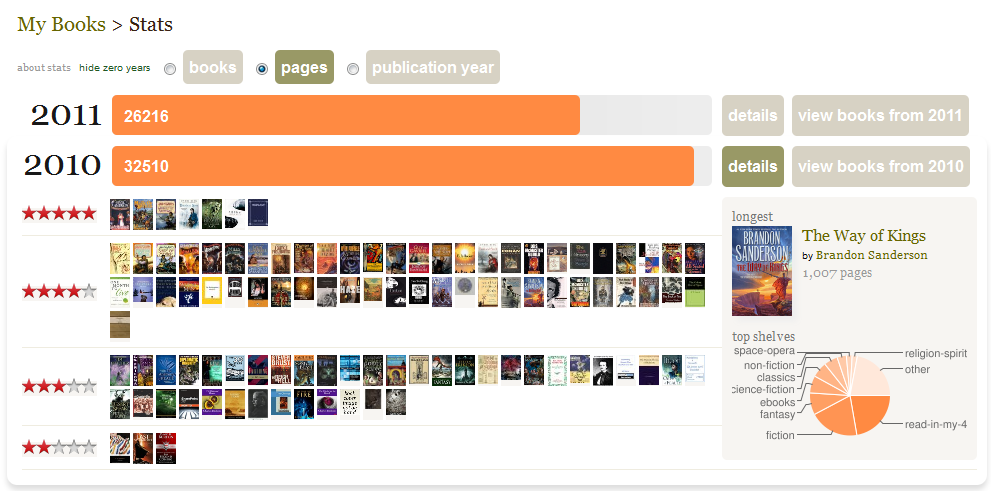
Why did epic fantasy appeal to me? The size of the books. Yes, I prefer tomes. The longer the book (or series), the happier I am. I read fast (not as fast as I did during my young adult hood, but still no slouch). Of the three novels shown in the photo above, the Janny Wurts novel on my Nook Color is the longest, weighing in at 749 pages. The classic, by Twain, and Vinge's Rainbow's End are actually approximately the same size in length: between 350 and 400 pages. If I put my mind to it, had few distractions, and really enjoyed the novel, I could finish either of the paperbacks in a day. Janny's writing, however, is dense, rich and full of revelations and layers that require concentration. I will enjoy her prose for a minimum of ten days, and again in the future, because there's always something new to find in her work when you re-visit it.

While Janny's latest publication, the very recently released Initiate's Trial, seems long to the casual reader at nearly twice the size of a normal paperback, to me it is a good sized epic fantasy novel. The longest books I've read in the last three years include:
  1. Jonathan Strange & Mr. Norrell (read in 2009) ~ 1,024 pages
  2. The Way of Kings (read in 2010) ~ 1,007 pages
  3. The Wise Man's Fear (read in 2011) ~ 994 pages
For more of my book stats, visit my stats page at GoodReads.


Book Clubs

I spent most of the 90s and the first half of the 00s raising children and helping my chronically ill husband all while working full-time. So basically, for a decade or a decade and a half, I stopped reading. Not completely, of course, because I read technical manuals and references guides for work and I occasionally picked up a novel off the new release shelf at the library. But I had blinders on and wasn't taking advantage of the wealth of information available via the Internet. About three years ago, a friend on Facebook invited me to join GoodReads, a social network site for bibliophiles. I felt like I'd found the keys to the gates of heaven. I quickly found online book clubs that aligned with my readings interests, signing up immediately with the Science Fiction and Fantasy Book Club. That quickly followed with Beyond Reality (which seems to be my favorite place to hang out for the moment). Eventually, I joined (and now help moderate) the Fantasy Book Club and the sister group Fantasy Book Club Series.

Photo0960.jpgMy awareness of reading and reviewing skyrocketed and pushed me to branch out in the 'real world.' Conveniently located in the building I spend every weekday in is a branch of the Kansas City Public Library. I participated in reading challenges and seasonal book clubs, some of which I've written blog posts about here (including: 'A Taste of Victorian Literature'; 'Altered States'; and, 'The Big Read' featuring Twain's Adventures of Tom Sawyer).


Accessible Authors

As if reading, reviewing and discussing novels wasn't wonderful enough, the real icing on the cake comes from the authors themselves. Unlike in the 80s when I had to write a letter on a manual typewriter and snail mail it to one of my favorite authors with a question (I did this with Barbara Hambly, Piers Anthony and Stephen R. Donaldson - all of whom replied courtesy the self-addressed stamped enveloped I provided them), today's authors write blogs, tweet via Twitter and participate eagerly at GoodReads either as discussion leaders or via dedicated Q&A topics posted for the chosen Book of the Month they wrote. Without their talent, imagination, perseverance and passion, I would have less to read, both in quantity and quality.

I highly recommend the following author blogs:

Back to the Future

I still love the heft of a heavy hardcover edition of a treasured classic epic fantasy ... for about five minutes. I may have turned the final page of my last new hardcover. Any future purchases will be made solely to support a favorite author, with the hope of meeting the author and asking for their autograph on the title page. For the lion's share of my reading, and to preserve both my weakening eyesight and the strain on my hands and arms, I will peruse the hundreds of novels and thousands of pages on my Nook Color ereader tablet, which is smart enough to turn off the light and mark my page when I doze off to sleep each night. Thanks again to my husband, for gifting me with this amazing product.

Saturday, September 10, 2011

Book Review: To Ride Hell's Chasm by Janny Wurts

I returned from Dragon*Con yesterday, after having a great visit with Janny, and realized I had not published my review of her excellent stand-alone fantasy novel To Ride Hell's Chasm, which I read nearly two years ago (and the story and characters are still vividly engraved on my mind). I highly recommend this novel.
 
To Ride Hell's ChasmTo Ride Hell's Chasm
by Janny Wurts
My rating: 5 of 5 stars

I finished this two hours ago (on 10/18/2009) and my emotions still wring me with spasms. The breakneck ride to the end felt like the crest of a tsunami or a primal volcanic eruption. I absolutely could not tear my eyes away from the page, nor turn them fast enough to keep up as the story unfolded.

For the first half of the novel, I struggled a bit to connect with the characters, but Mykkael and Anja's crucible experience came into visceral focus, never letting go their grip on my heart until the last song was sung.

I must force myself to keep this brief, because anything I discern or divulge will spoil the ride of your life down Hell's Chasm.

I highly recommend this outstanding stand-alone fantasy novel by Janny Wurts.

Beyond Reality October 2009 Fantasy Selection (click here to peruse the discussion thread and feel free to post questions or comments).

View all my reviews

Wednesday, August 24, 2011

Book Review: Leviathan by Westerfeld

Leviathan (Leviathan, #1)Leviathan by Scott Westerfeld

My rating: 3 of 5 stars

I read this in mid June 2011 as a member of the Fantasy Book Club group read. A quick, easy read, as I expected from a young adult novel, and one of my first (if not the first) steampunk stories. I learned quite a bit about pre-World War I Europe through my tangential research to better understand the alternate view of those events presented by the author. I definitely related to the Clankers, one of the political powers of this world represented by the familiar Austrian-Hungarian Empire. The Darwinists, on the other hand, fascinated but left me queasy (similar to how I feel now about genetically modified flora and fauna). The inevitable intertwining of the two worlds from our two protagonists provided good action and drama, and some character development, but the ending just frustrated me. If you don't like very abrupt cliffhangers, you might want to have the sequels, Behemoth and Goliath, on hand when you finish Leviathan.

View all my reviews

Saturday, August 13, 2011

Book Review: Consider Phlebas by Banks

Consider PhlebasConsider Phlebas by Iain M. Banks

My rating: 2 of 5 stars

2.5 stars

My first attempt to read Consider Phlebas began a couple of years ago. I made it to the fifth chapter and abandoned the book. This past June, the SciFi and Fantasy Book Club selected Consider Phlebas as the science fiction group read. The discussion leader provided two avenues for discourse: by topic or by chapter. I opted for the chapter course, hoping that by only absorbing one chapter per day I might actually finish the novel. Some chapters made better lunch reading than others (for example, if you're squeamish, you might avoid the sixth chapter, or at least avoid masticating and digesting dinner while reading it).

With my support and therapy groups ready and willing to urge me on, I reluctantly consumed a chapter a day and finished my first (and perhaps last) Culture novel. Many of my thoughts and comments can be found in the discussion threads here.

Banks' writing style lent itself to rich cinematic visualizations, especially of some of the action sequences (escaping from space ships, orbital rings, runaway trains). Those images, created by Banks' prose and my own imagination, are forever seared into my memories, some of them as vivid and visceral as a strobe light flash in a Halloween haunted horror house.

My most intriguing find resulted from the epigraph which quoted two lines from T.S. Eliot's The Waste Land and directly relate to the title and the tone of the novel. My research lead me to further contextual reading in The Waste Land to include the entire section surrounding the epigraph quote:

IV. DEATH BY WATER

Phlebas the Phoenician, a fortnight dead,
Forgot the cry of gulls, and the deep sea swell
And the profit and loss.
A current under sea
Picked his bones in whispers. As he rose and fell
He passed the stages of his age and youth
Entering the whirlpool.
Gentile or Jew
O you who turn the wheel and look to windward,
Consider Phlebas, who was once handsome and tall as you.
T.S. Eliot, The Waste Land


I found few likable or relateable characters, with the exception of the robots and Minds (Banks' AI permutation). Knowing nothing of the Culture prior to reading Consider Phlebas, and in light of the quote above, I can understand and appreciate the author's endeavor. Just not my cup of tea.

View all my reviews

Space Opera Showdown Minus the Corral

September is Space Opera month at the five thousand strong (and growing) SciFi and Fantasy Book Club on GoodReads. Wikipedia offers this definition of Space Opera:
Space opera is a subgenre of speculative fiction that emphasizes romantic, often melodramatic adventure, set mainly or entirely in outer space, generally involving conflict between opponents possessing advanced technologies and abilities. The term has no relation to music and it is analogous to "soap opera" (see below). Perhaps the most significant trait of space opera is that settings, characters, battles, powers, and themes tend to be very large-scale.

Sometimes the term space opera is used pejoratively to denote bad quality science fiction, but its meaning can differ, often describing a particular science fiction genre without any value judgement.
So help us choose from among these excellent contenders and make our September space opera adventure glorious!

Pandora's Star by Hamilton

The Tar-Aiym Krang by Foster

Heir of Empire by Zahn


A Deepness in the Sky by Vinge

Downbelow Station by Cherryh

Leviathan Wakes by Corey


Monday, July 11, 2011

Book Review: The Summer Tree by Kay

The Summer Tree (The Fionavar Tapestry, #1)The Summer Tree by Guy Gavriel Kay

My rating: 4 of 5 stars

I took quite some time to warm-up to this earliest novel of Guy Gavriel Kay. I just couldn't get excited about five Canadian college students agreeing (with the exception of one malcontent ... but there's always got to be one rebel) to be whisked or warped or rifted or transported (take your pick) to the world of Fionavar just to attend the king's jubilee. Thrust into a seemingly medieval setting, complete with court politics, royal succession quandaries, manipulative magicians, kingdom-wide drought and blight and an approaching storm of vengeful evil, these young men and women adapt readily and a bit unbelievably. Even the initial loss of one in the crossing barely causes a blip of concern once the remaining four become embroiled in the avalanche of events bearing down on the kingdom.

Of all the characters, both from our world and Finovar, I respected Dave the most as well as Sharra (and I hope to learn more about her in the rest of the series). Paul seemed to excel at doing the right things for all the wrong reasons. Kimberly went native almost before leaving Earth, but Kevin remains an enigma to me. I barely glimpsed Jennifer's tribulations and fear for her fate.

I saw the influence of Celtic mythology throughout Kay's worldbuilding and drew parallels with other epic fantasies prevalent and popular in the late 70s and early 80s (Tolkien, Lewis and to a lesser extent Brooks).

I suspect I missed reading the Fionavar Tapestry in high school and early college because I had to rely on what I saw at the grocery store book/magazine aisle, since I didn't have access to a library or a book store and GoodReads wasn't even a gleam on the Internet's nascent horizon. Had I read this series then, I am confident I would have added it to my permanent re-read collection. While The Summer Tree and the rest of the Fionavar Tapestry will remain on my shelves besides Kay's other later great novels, I doubt I'll be tempted to re-read it. Not with Tigana or the Lions of Al-Rassan enticing me to return and relive the wonder and the glory.

For further insights, please visit the discussion threads at the GoodReads Science Fiction and Fantasy Book Club held in June 2011.

View all my reviews

Friday, July 1, 2011

Summer Reads - Second Third

I met all my reading goals for the first month of summer. I loaded up the first of the month with the authors I knew would delivery excellent stories, leaving the unknown frontier of my book club selections for the middle and end of June. I devoted the last week of the month to reading the first in a relatively new fantasy series by Kevin J. Anderson that I've been surprised and engrossed in for days. The third book in his Terra Incognita series releases in a couple of weeks, so I'm all fired up to read the second book as soon as possible.

For July, my GoodReads book clubs are hit and miss:

Over at Fantasy Book Club Series, we're continuing in the Empire Triology with Servant of the Empire. I'm looking forward to reading what Mara plots next for the Game of Counsel on Kelewan.

The Science Fiction & Fantasy Book Club selected The Snow Queen for our July scifi reading pleasure. I've had this book on my shelves for years and finally have no excuse not to read it.

Neither selection at Beyond Reality for July appeals to me, but we are accepting nominations for our next series read and will probably have the poll up for voting by the time this blog post publishes.

The Fantasy Book Club decided to read the ever-popular Wizard of Earthsea in July. Since I've read this classic by Le Guinn several times already, including recently when the Syfy channel aired a mini-series based on the trilogy, I'm going to skip another re-read this time around.

For Fantasy Literature, I need to read and review Sorcery Rising and listen to Dragongirl.

I'll round out July by continuing in the Fionavar Tapestry with The Wandering Fire. And, if I can acquire a copy of the second novel in Terra Incognita, I'll continue exploring and searching for the lost continent of Terravitae in The Map of All Things.

Friday Morning Update: I actually finished The Edge of the World a couple of days ago (but with the holiday weekend I won't get a review written for a few days). As filler to round out the last couple of days of June, I started reading one of Barnes & Nobles 'free Friday' Nook Books from a couple of weeks ago entitled Stupid History. Aptly titled and I should whip through it in record time, leaving my intelligence intact (I hope). The best surprise I got this morning, though, was the companion progressive rock CD released by Rosswell Six called Beyond the Horizaon. I listened to the first four tracks on the drive in to work today and I felt transported back to the glory days of the 70s and rock bands I grew up with (and savored) like Kansas, Rush and Styx. Click on the CD cover icon to listen to excerpts of the songs:

Monday, June 27, 2011

Book Review: In the Garden of Iden by Baker

In the Garden of Iden (The Company, #1)In the Garden of Iden by Kage Baker

My rating: 3 of 5 stars

2.5 stars

My first exposure to Kage Baker's writing and to her Company series. In our future (about two centuries ahead of us), both time travel and immortality are discovered. As with most time travel scenarios in science fiction, history can't be rewritten, so said travel is of limited use to the plot and the science is foggy at best. Time travel then becomes a means to transport the reader to a different point in our past. Equally useless to the entrepreneurs of the 24th century is immortality, which can only be applied to very young children and requires extensive cybernetic enhancement.

The Company (aka Dr. Suess) still finds a way to make a buck, sending scientists back to the distant past, recruiting young children from the native population, installing immortality, and putting them to work by scavenging and salvaging priceless art, books, plants, etc. for re-discovery and re-sale (by the Company of course) in the 24th century.

Mendoza is an orphan from the Spanish Inquisition rescued and then recruited by the Company at the very edge of the Pit. After several years of operations and education, she receives her first field assignment, not in the New World (as she desired to be as far as possible away from 'the monkeys'), but in dreary damp England. While collecting rare specimens from the Garden of Iden, she falls in love with one of the manor's servants, a fiercely fanatical Protestant young man adrift in a resurgence of Catholicism courtesy of Queen Mary and Prince Phillip of Spain.

I enjoyed the historical aspects of the novel, especially England during the Counter-Reformation. Kage Baker did a good job of immersing me in both Spain and England. I still prefer Connie Willis' writing style as evidenced in The Doomsday Book and her other Oxford time travel novels and stories.

I'm not a fan of romance, especially teenage romance (and Mendoza is in her late teens while on this first assignment), so I struggled through about half of this book. I also missed some of the humor (or failed to register it as such) exhibited by her fellow agents and their reactions to the 'monkeys' (the cyborg agents' derogatory term for mere mortal men). The predictably tragic ending arrived to my great relief and the novel finally moved back to the original mission - preserving plants.

Perhaps I took the fear and loathing of the immortal agents towards human beings too much to heart. It concerned me that these agents of the Company felt such disdain and dread towards their former brothers and sisters. Commerce and computers seized the day, while the monkeys scampered about and threw bananas at each other. I got the distinct impression that the Company and civilization of the 24th century felt humans were irredeemably inclined to violence and destruction, in a constantly repeating cycle.

I read this novel as part of the Beyond Reality June 2011 book of the month selection for science fiction. To follow or join in the discussion, please stop by our site.


View all my reviews

Monday, June 20, 2011

Book Review: Daughter of the Empire by Feist and Wurts

Daughter of the Empire (The Empire Trilogy, #1)Daughter of the Empire by Raymond E. Feist

My rating: 4 of 5 stars

I could never see myself becoming a Mara, but I thoroughly enjoyed reading of her struggles and setbacks, her uncanny ability to turn even the most desperate tragedy into a resounding triumph. Daughter of Empire occurs on Kelewan, the home world of the Tsuranuanni, the flip-side of the coin that embodies the Riftwar Saga (as told mostly from Midkemia through Magician, Silverthorn and A Darkness at Sethanon).

Despite a near complete lack of traditional fantasy elements, this novel delivers an astonishing number of surprises, twists, intrigues and gambles. The rich world of Kelewan and the culture and heritage that is the Tsuranuanni Empire infuse all aspects of the reading experience. Mara's journey from virginal novitiate to one of the twenty gods of the Tsuranuanni to ruthless Ruling Lady of one of the oldest Houses in the Empire steeped us in her gut-wrenching grief, unflinching resolve through spousal abuse and sweet relief through each successful gambit in the Game of the Council.

I plan to continue reading the rest of the Empire Trilogy and highly recommend this first installment in that series.

For more discussions of Daughter of Empire, led by one of the authors, Janny Wurts, and including a Q&A thread with Raymond E. Feist, follow this link.

View all my reviews

Thursday, June 2, 2011

Book Review: A Darkness at Sethanon by Feist

A Darkness at Sethanon (The Riftwar Saga, #4)A Darkness at Sethanon by Raymond E. Feist

My rating: 4 of 5 stars

The final installment to the Riftwar Saga series contained page-turning action and most of the answers to mysteries and questions posed from earlier in the series, including a surprise twist that posed ... more questions. While I enjoyed reading A Darkness at Sethanon, I felt the characters gained less growth this time around, being more reactive to the harsh circumstances thrown at them on their quest to stop Murandamus. The Pug, Tomas and Macros cameo chapters intrigued me the most, providing more background about themselves and the other elves, and more worldbuilding with glimpses of rift space and the end or beginning of the universe.

I enjoyed reading this series and feel it provides a good solid fantasy adventure story.

View all my reviews

Wednesday, June 1, 2011

First Third of My Summer Reads - June 2011

Just a few of my favorite things . . . thanks to participating in GoodReads groups and as a guest reviewer for FantasyLiterature.com:

SciFi and Fantasy Book Club's currently-reading book montage

SciFi and Fantasy Book Club 5029 members
Welcome to the SciFi and Fantasy Book Club!


Books we're currently reading

Start date: June 1, 2011

View this group on Goodreads »

Share book reviews and ratings with SciFi and Fantasy Book Club, and even join a book club on Goodreads.

Beyond Reality's to-read book montage

Beyond Reality 747 members

Welcome to the Beyond Reality SF&F discussion group on GoodReads. In Beyond Reality, each of our me...


Books we plan to read

Start date: June 1, 2011 *

Start date: June 1, 2011
View this group on Goodreads »

Share book reviews and ratings with Beyond Reality, and even join a book club on Goodreads.

Fantasy Book Club's currently-reading book montage

Fantasy Book Club 2950 members

For lovers of Fantasy, monthly book discussions
May read: The Name of the Wind by...


Books we're currently reading

LeviathanLeviathan
by Scott Westerfeld 

Start date: June 1, 2011
View this group on Goodreads »

Share book reviews and ratings with Fantasy Book Club, and even join a book club on Goodreads.


Fantasy Book Club Series's currently-reading book montage

Fantasy Book Club Series 300 members

Can't resist the lure of an epic saga full of fantastic creatures, scintillating sorcery, heroic...


Books we're currently reading

Start date: May 15, 2011 *

Start date: June 1, 2011
View this group on Goodreads »

Share book reviews and ratings with Fantasy Book Club Series, and even join a book club on Goodreads.

* I am not reading these selections.

Anything else I tackle this month can be found on my current-month book shelf at GoodReads.

Wednesday, April 27, 2011

Book Review: Silverthorn by Feist

Silverthorn (The Riftwar Saga, #3)Silverthorn by Raymond E. Feist

My rating: 4 of 5 stars

(To view spoilers, please highlight this redacted text.)

With the closing of the rift at the end of Magician, I wondered where Raymond Feist would take me in Silverthorn, the next novel in the Riftwar Saga series. The three brothers (Arutha, Lyam and Martin) spent a year touring the Kingdom and returned to Krondor to plan Arutha and Anita's wedding. Jimmy the Hand, a young full-of-himself thief and rising star in the Mockers, foiled an assassination attempt upon Prince Arutha. Because Jimmy aided both Anita and Arutha in escaping Krondor during the Riftwar, he chose to warn Arutha before reporting to the Mockers, and for his divided loyalty he was branded a traitor by his Guild. Arutha haggled with the Upright Man, the leader of the Mockers and, unknown to Jimmy, his father. Arutha agrees to make Jimmy his Squire and the Mockers agree to hunt for the Night Hawk assassins. With the Mockers' assistance, Arutha invades the Night Hawks' hideout in Krondor, but what should have been a rout, instead turns into a zombie apocalypse melee until Jimmy burns the place down around them.

Thinking the threats to his life abated, Arutha and Anita proceed with their wedding. Jimmy gets a bad feeling and restlessly searches the upper galleries of the hall, stumbling upon a former high-ranking Mocker now turned assassin. Despite being knocked senseless, gagged and restrained, Jimmy manages to divert the assassin's shot, which misses Arutha but strikes his bride-to-be Anita. Even the great Pug can't cure Anita, so he places a spell upon her that slows time down to a barely perceptible crawl, allowing Arutha time to find an antidote for the poison. An interrogation session with the assassin reveals the name of the poison (and also the antidote) to be 'silverthorn' but no one on hand in Krondor has ever heard of it.

Thus, a quest is begun. Pug returns to Stardock to search Macros' library and eventually discovers a way to return to Kelewan, where an even more comprehensive library exists founded by the Tsurani Assembly of Great Ones. Predictably, Pug is detained as a result of his last acts at the Imperial Games before closing the rift. Meanwhile, Arutha and a small party, including Jimmy, head to the Kingdom's own repository of knowledge at Sarth.

Eventually, knowledge of the silverthorn is gleaned and Arutha's party seeks it through elven territory in the west and the far northern reaches of Midkemia. Pug extricates himself from detention and goes on his own quest for the Watchers, also in the far northern reaches, but on Kelewan. Both storylines include action, adventure, danger, puzzles and more walking dead. Jimmy provides some sidekick humor to lighten the mood.

Arutha returns with the antidote and saves Anita. Jimmy continues his campaign to become Duke of Krondor. Pug finds the Watchers and agrees to be instructed in magic for a year.

Silverthorn delivered an almost typical quest adventure, focusing on Arutha's obsessive need to save Anita and Jimmy's transition from thief to trusted companion and squire to Arutha. Even though Pug only popped in for a few chapters, I am positive his quest will result in further adventures in later novels. Tomas appeared only in a couple of brief cameos, but at least he's settling in nicely among the elves and fatherhood agrees with him. Princess Caroline, twice bereft of lovers in Magician, sets her sights on Laurie and I see another royal wedding in the near future.

Probably not quite a four star rating, but definitely better than three or three and a half. Stop in at Fantasy Book Club Series group to review discussions of Silverthorn (with a Q&A thread monitored by Raymond E. Feist) from April 2011.

View all my reviews

Wednesday, April 20, 2011

Book Review: Magician: Master by Feist

Magician: Master (The Riftwar Saga, #2)Magician: Master by Raymond E. Feist

My rating: 4 of 5 stars

The second half of Magician became increasingly dark as I approached the climactic end to the Kelewan-Midkemian Riftwar. I observed definite growth to full maturity between Pug and Tomas, and perhaps that growth from boyhood through young adult into adulthood is what I lament - the rite of passage of most normal young boys, though Pug and Tomas could never be mistaken for normal. While everything seemed wondrous and adventurous in the first half of the novel (also known as Magician: Apprentice), I felt the oppression of circumstances, the collision of events and the machinations of a magician previously thought trustworthy. Not all was dark and gloomy, yet I didn't walk away from this book thinking it ended on a resoundingly happy note.

A couple of scenes stood out as a bit over-the-top and stretched the envelope of believability: Milamber's reaction to the Imperial Games and Tomas' ability to overcome a dead dreaded god-like being with his boyish mental fortitude. And I can't deny I felt gut-punched by the eleventh-hour betrayal by Macros. (to view spoiler, please highlight this paragraph).

For a debut work, I applaud Raymond Feist for a magnificent tale and the beginning to a well-loved fantasy epic. I'm continuing the Riftwar Saga by reading Silverthorn this month.

View all my reviews

Monday, April 4, 2011

Currently Reading (Apr 2011): The Mill on the Floss by Eliott

The Mill on the FlossThe Mill on the Floss by George Eliot

I'm reading this, my third Victorian literature, as part of the KC Public Library's 'A Taste of Victorian Literature' reading group. I'll be reading this throughout the month of April 2011 and will join the group at the Plaza Branch on Wednesday, April 27, 2011 at 6:30 p.m. for a lecture and discussion.

The following were provided in handouts from the Kansas City Public Library, emailed to the participants in the reading group.

About the Book:

The title of this novel is a succinct description of both the setting and the chief external conflict: the Dorlcote Mill located on the River Floss, which is operated by the Tulliver family. The business creates conflict within the family as Mr. Tulliver sends his doltish son Tom for schooling (in preparation to run the mill) rather than his bright and bookish daughter Maggie. After a lawsuit threatens to bankrupt him, Mr. Tulliver asks his son to swear an oath of enmity on the family Bible – an oath that soon changes Maggie’s life as well.

The nuanced relationship between Tom and Maggie is the novel’s foremost concern as the siblings unintentionally create a snowballing series of tragedies. Meanwhile, Eliot applies a keen moral sense to all her characters. Few are left unscathed.

The Mill on the Floss presents one of the finest portraits of domestic life in the early Victorian era, offering readers insights into the rituals of meals as well as the procurement and preparation of food. Eliot’s acute eye for village life also manifests in colloquial dialogue.

A true Victorian novel given its time period, The Mill on the Floss is also a distinctly modern novel in that Eliot gives all the characters true minds of their own: psychology trumps plot and narrative convenience and even reader expectation.

About the Author:

George Eliot (1819 – 1880) took up her career as a novelist later than most. Named Mary Ann Evans, she grew up in a modest home and attended school under the influence of an evangelical spinster. She left school as a teenager in order to care for her father, who would be her near constant companion for the next 15 years until his death. During this time, she struggled with her own concept of moral duty as well as religious notions that nearly compelled her to forsake reading for pleasure.

At 35, Eliot fell in love with George Henry Lewes, a married man prevented by Victorian law from obtaining a divorce from his wife despite her infidelity, which produced four children. Rejecting respectability and social custom, Eliot lived with Lewes as his unmarried wife. This happy union proved the catalyst for Eliot to take up the pen.

Eliot published her first novel Adam Bede in 1859, adopting at that time the convention of female authors taking male pseudonyms. Widely hailed by critics and the public alike, only Charles Dickens immediately identified this debut author as an incredibly talented woman. The Mill on the Floss (1860), her second novel, proved part autobiographical in its depiction of a close brother-sister relationship.

Eliot wrote several more important novels: Silas Marner (1861), Romola (1862), Felix Holt (1866), Middlemarch (1871), and Daniel Deronda (1876). She passed away in 1880, two years after Lewes died.

In her time, Eliot was known as the greatest living English novelist. She is praised for her focus on the psychology of her characters as well as the moral force of her fiction and its intelligence. Virginia Woolf would later defend Eliot against disparaging attacks by declaring Middlemarch as “one of the few English novels written for grown-up people.”

Discussion Topics for The Mill on the Floss

  1. Childhood and falling in love are two main themes of Mill on the Floss. How do the provincial values and customs of St. Ogg’s stunt the main characters’ growth and frustrate their romantic relationships?
  2. Eliot believed that the art of fiction told truths of its own, through invention. What truths about life does Mill on the Floss get at? Which of these truths might be considered timeless?
  3. The word “respectable” comes up repeatedly in this novel. What does it mean, within the context of early Victorian society?
  4. What do we learn in this novel regarding Victorian attitudes towards children? What role does class play in these attitudes?
  5. Water is the novel’s most important motif or recurring symbol. How does Eliot use water to foreshadow the plot, to highlight certain themes? What does water symbolize?
  6. Who is the narrator? What role does this narrator play?
  7. What is the importance of family in this novel? In Victorian society at large?
View all my reviews

Thursday, March 24, 2011

Book Review, Lecture and Discussion: Jane Eyre by Charlotte Brontë

Jane Eyre (Penguin Classics)Jane Eyre by Charlotte Brontë

My rating: 4 of 5 stars


I skimmed through this prior to attending the lecture and discussion sponsored by the Kansas City Public Library as the second of four novels in their 'A Taste of Victorian Literature' series. For a full report on the event, please visit my blog post entitled 'Charlotte Bronte Burns Through the Cool Veil of Jane Eyre' (warning: it's four pages long, so don't forget to click through to the rest of the post when you reach the bottom of a page).


Visit my review from May 2009 for my thoughts, insights and first impressions into Jane Eyre.

View all my reviews

Friday, March 18, 2011

Book Review: It Can't Happen Here by Lewis

It Can't Happen Here (Signet Classics)It Can't Happen Here by Sinclair Lewis
My rating: 3 of 5 stars

Written in the 30s, during the depths of the Depression, before World War II, this dystopian classic paints a grim picture of America's fall into it's own flavor of fascism. Some of his assertions stretched my belief nearly to the breaking point, most notable being the seemingly easy evaporation of two of our three branches of government after the League of Forgotten Men rise in power and seize the executive branch.

The novel follows the life of Jessup Doremus, an elderly (nearly retirement age) editor of a small town Vermont newspaper, uniquely positioned to lead us down the slippery slope of disappearing civil liberties and rising paranoia among the citizenry. The evils promulgated by petty near-thugs upon strangers, neighbors, friends and family ... almost indiscriminately ... all as an exercise in absolute power (as far as I could tell).

Not a comforting read, except for a brief glimpse of hope at the end. I can understand the shock value it would have had when it was published. I'm glad I read it, and even more glad none of it has proved prophetic for America ... yet.

I read this novel as one of the suggested readings for my local library's adult winter reading program called 'Altered States' and blogged about my reading journey.

View all my reviews