Showing posts with label GoodReads. Show all posts

Sunday, March 18, 2012

Book Review: The Terror by Simmons


The Terror

The Terror by Dan Simmons

My rating: 4 of 5 stars

I read The Terror as part of a group read at the Science Fiction & Fantasy Book Club at GoodReads during the month of February. I participated in the discussion, as did many others. To review those threads, please follow this link.

I started reading this the evening of February 13th, with snowfall predicted to commence after midnight. I sat shivering at the kitchen table while I read the first few chapters, even though the furnace kept my house a toasty 78 degrees Fahrenheit. I even dug out a blanket to put on the bed before I went to sleep (still shivering). Brrrr..... Great writing by Dan Simmons, atmospherically speaking.

 And I restrained my insatiable desire to research the quest for the Northwest Passage and specifically the final voyage of the HMS Terror until after I finished reading the novel. Simmons kept me riveted until the last few chapters, when he decided to take an extreme detour into arctic supernatural spirituality that left me, well, cold.

Still, a great read by an outstanding author. I recommend lots of warm tea or cocoa and abstinence from long pork.

 View all my reviews

Book Review: Archangel by Shinn

Archangel (Samaria, #1)Archangel by Sharon Shinn

My rating: 4 of 5 stars

Beyond Reality February 2012 Science Fiction Selection

The protagonist, Rachel, grabbed me immediately. Not only was she a superb vocalist, she reminded me in so many ways of my own daughter, also named Rachelle, and who is also a superb vocalist (mezzo soprano, though, instead of Rachel's coloratura soprano). As soon as I finished the book, I sent a recommendation off to my Rachelle, hoping she'd read it and enjoy it as much as I did.

The religious references intrigued me (and sometimes made me laugh - did anyone else think that the name of Semorrah was a mashed-up condensation of Sodom and Gemorrah?) and the musical elements fascinated me. I play piano, attempt to sing (not as well trained as my daughter, so I gave it up as a lost cause at this point in my life) and I know basic music theory. My husband has years of training (jazz trumpet and guitar), composes music and has perfect relative pitch; all of which he passed on to our daughter.

On the question of whether this novel is science fiction or fantasy, I leaned towards the former early on. Once introduced to the oracle Josiah in Archangel, I began to believe I was reading a science fiction story (perhaps along the lines of Pern?). But the rest of the novel revealed little beyond that scene with the Oracle. Another clue could also be derived from the 'smallness' of their 'planet' in area and scope.

I interpreted the singing as magical. The story is mostly a romance, which I normally avoid like the plague, but in this case it worked well.

I have not decided yet if I will continue this series. I'll have to research my friends' reviews of it and see if it gets better or if this installment is as good as it gets.

 All in all, I really enjoyed Archangel, even if it seemed to be a romance masquerading as a fantasy with hints of science fiction sprinkled throughout.

 View all my reviews

Thursday, November 3, 2011

Reader of the Vast Tomes

For the third day of my 'Thirty Days of Thankfulness' I wish to express my appreciation of reading books. I can't remember of a time when I didn't know how to read, going clear back to when I was three or four years old. By the time I finished second grade, I believe I had finished all the Laura Ingalls Wilder Prairie books and started working through my mom's old collection of Nancy Drew novels (printed in the 30s or before), as well as a few Hardy Boys and Trixie Beldon mysteries. I also remember reading Black Beauty and Little Women several times. Alice in Wonderland and Through the Looking Glass come to mind as well as some Jules Verne. I loved (and still re-read) C.S. Lewis Chronicles of Narnia and own a large hardcover omnibus edition, which I place prominently on my Shelf of Honor.

As I approached middle school age, I became exposed to other genres, including science fiction and horror. During my early teen years, I couldn't read enough Stephen King. I still consider The Stand to be one of his best novels and a great example of post-apocalyptic fiction. But there came a point when the thrills paled and the terror became predictable. I did an about-face, a complete one-eighty and dived into epic fantasy. I have rarely, if ever, looked back.

Epic Fantasy Tomes

Why did epic fantasy appeal to me? The size of the books. Yes, I prefer tomes. The longer the book (or series), the happier I am. I read fast (not as fast as I did during my young adult hood, but still no slouch). Of the three novels shown in the photo above, the Janny Wurts novel on my Nook Color is the longest, weighing in at 749 pages. The classic, by Twain, and Vinge's Rainbow's End are actually approximately the same size in length: between 350 and 400 pages. If I put my mind to it, had few distractions, and really enjoyed the novel, I could finish either of the paperbacks in a day. Janny's writing, however, is dense, rich and full of revelations and layers that require concentration. I will enjoy her prose for a minimum of ten days, and again in the future, because there's always something new to find in her work when you re-visit it.

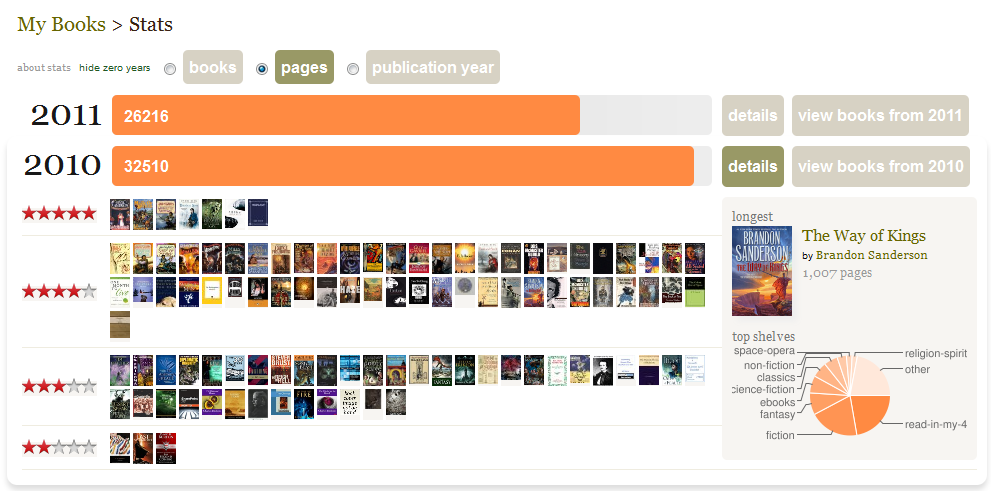
While Janny's latest publication, the very recently released Initiate's Trial, seems long to the casual reader at nearly twice the size of a normal paperback, to me it is a good sized epic fantasy novel. The longest books I've read in the last three years include:
  1. Jonathan Strange & Mr. Norrell (read in 2009) ~ 1,024 pages
  2. The Way of Kings (read in 2010) ~ 1,007 pages
  3. The Wise Man's Fear (read in 2011) ~ 994 pages
For more of my book stats, visit my stats page at GoodReads.


Book Clubs

I spent most of the 90s and the first half of the 00s raising children and helping my chronically ill husband all while working full-time. So basically, for a decade or a decade and a half, I stopped reading. Not completely, of course, because I read technical manuals and references guides for work and I occasionally picked up a novel off the new release shelf at the library. But I had blinders on and wasn't taking advantage of the wealth of information available via the Internet. About three years ago, a friend on Facebook invited me to join GoodReads, a social network site for bibliophiles. I felt like I'd found the keys to the gates of heaven. I quickly found online book clubs that aligned with my readings interests, signing up immediately with the Science Fiction and Fantasy Book Club. That quickly followed with Beyond Reality (which seems to be my favorite place to hang out for the moment). Eventually, I joined (and now help moderate) the Fantasy Book Club and the sister group Fantasy Book Club Series.

Photo0960.jpgMy awareness of reading and reviewing skyrocketed and pushed me to branch out in the 'real world.' Conveniently located in the building I spend every weekday in is a branch of the Kansas City Public Library. I participated in reading challenges and seasonal book clubs, some of which I've written blog posts about here (including: 'A Taste of Victorian Literature'; 'Altered States'; and, 'The Big Read' featuring Twain's Adventures of Tom Sawyer).


Accessible Authors

As if reading, reviewing and discussing novels wasn't wonderful enough, the real icing on the cake comes from the authors themselves. Unlike in the 80s when I had to write a letter on a manual typewriter and snail mail it to one of my favorite authors with a question (I did this with Barbara Hambly, Piers Anthony and Stephen R. Donaldson - all of whom replied courtesy the self-addressed stamped enveloped I provided them), today's authors write blogs, tweet via Twitter and participate eagerly at GoodReads either as discussion leaders or via dedicated Q&A topics posted for the chosen Book of the Month they wrote. Without their talent, imagination, perseverance and passion, I would have less to read, both in quantity and quality.

I highly recommend the following author blogs:

Back to the Future

I still love the heft of a heavy hardcover edition of a treasured classic epic fantasy ... for about five minutes. I may have turned the final page of my last new hardcover. Any future purchases will be made solely to support a favorite author, with the hope of meeting the author and asking for their autograph on the title page. For the lion's share of my reading, and to preserve both my weakening eyesight and the strain on my hands and arms, I will peruse the hundreds of novels and thousands of pages on my Nook Color ereader tablet, which is smart enough to turn off the light and mark my page when I doze off to sleep each night. Thanks again to my husband, for gifting me with this amazing product.

Saturday, September 10, 2011

Book Review: To Ride Hell's Chasm by Janny Wurts

I returned from Dragon*Con yesterday, after having a great visit with Janny, and realized I had not published my review of her excellent stand-alone fantasy novel To Ride Hell's Chasm, which I read nearly two years ago (and the story and characters are still vividly engraved on my mind). I highly recommend this novel.
 
To Ride Hell's ChasmTo Ride Hell's Chasm
by Janny Wurts
My rating: 5 of 5 stars

I finished this two hours ago (on 10/18/2009) and my emotions still wring me with spasms. The breakneck ride to the end felt like the crest of a tsunami or a primal volcanic eruption. I absolutely could not tear my eyes away from the page, nor turn them fast enough to keep up as the story unfolded.

For the first half of the novel, I struggled a bit to connect with the characters, but Mykkael and Anja's crucible experience came into visceral focus, never letting go their grip on my heart until the last song was sung.

I must force myself to keep this brief, because anything I discern or divulge will spoil the ride of your life down Hell's Chasm.

I highly recommend this outstanding stand-alone fantasy novel by Janny Wurts.

Beyond Reality October 2009 Fantasy Selection (click here to peruse the discussion thread and feel free to post questions or comments).

View all my reviews

Wednesday, August 24, 2011

Book Review: Leviathan by Westerfeld

Leviathan (Leviathan, #1)Leviathan by Scott Westerfeld

My rating: 3 of 5 stars

I read this in mid June 2011 as a member of the Fantasy Book Club group read. A quick, easy read, as I expected from a young adult novel, and one of my first (if not the first) steampunk stories. I learned quite a bit about pre-World War I Europe through my tangential research to better understand the alternate view of those events presented by the author. I definitely related to the Clankers, one of the political powers of this world represented by the familiar Austrian-Hungarian Empire. The Darwinists, on the other hand, fascinated but left me queasy (similar to how I feel now about genetically modified flora and fauna). The inevitable intertwining of the two worlds from our two protagonists provided good action and drama, and some character development, but the ending just frustrated me. If you don't like very abrupt cliffhangers, you might want to have the sequels, Behemoth and Goliath, on hand when you finish Leviathan.

View all my reviews

Saturday, August 13, 2011

Book Review: Consider Phlebas by Banks

Consider PhlebasConsider Phlebas by Iain M. Banks

My rating: 2 of 5 stars

2.5 stars

My first attempt to read Consider Phlebas began a couple of years ago. I made it to the fifth chapter and abandoned the book. This past June, the SciFi and Fantasy Book Club selected Consider Phlebas as the science fiction group read. The discussion leader provided two avenues for discourse: by topic or by chapter. I opted for the chapter course, hoping that by only absorbing one chapter per day I might actually finish the novel. Some chapters made better lunch reading than others (for example, if you're squeamish, you might avoid the sixth chapter, or at least avoid masticating and digesting dinner while reading it).

With my support and therapy groups ready and willing to urge me on, I reluctantly consumed a chapter a day and finished my first (and perhaps last) Culture novel. Many of my thoughts and comments can be found in the discussion threads here.

Banks' writing style lent itself to rich cinematic visualizations, especially of some of the action sequences (escaping from space ships, orbital rings, runaway trains). Those images, created by Banks' prose and my own imagination, are forever seared into my memories, some of them as vivid and visceral as a strobe light flash in a Halloween haunted horror house.

My most intriguing find resulted from the epigraph which quoted two lines from T.S. Eliot's The Waste Land and directly relate to the title and the tone of the novel. My research lead me to further contextual reading in The Waste Land to include the entire section surrounding the epigraph quote:

IV. DEATH BY WATER

Phlebas the Phoenician, a fortnight dead,
Forgot the cry of gulls, and the deep sea swell
And the profit and loss.
A current under sea
Picked his bones in whispers. As he rose and fell
He passed the stages of his age and youth
Entering the whirlpool.
Gentile or Jew
O you who turn the wheel and look to windward,
Consider Phlebas, who was once handsome and tall as you.
T.S. Eliot, The Waste Land


I found few likable or relateable characters, with the exception of the robots and Minds (Banks' AI permutation). Knowing nothing of the Culture prior to reading Consider Phlebas, and in light of the quote above, I can understand and appreciate the author's endeavor. Just not my cup of tea.

View all my reviews

Space Opera Showdown Minus the Corral

September is Space Opera month at the five thousand strong (and growing) SciFi and Fantasy Book Club on GoodReads. Wikipedia offers this definition of Space Opera:
Space opera is a subgenre of speculative fiction that emphasizes romantic, often melodramatic adventure, set mainly or entirely in outer space, generally involving conflict between opponents possessing advanced technologies and abilities. The term has no relation to music and it is analogous to "soap opera" (see below). Perhaps the most significant trait of space opera is that settings, characters, battles, powers, and themes tend to be very large-scale.

Sometimes the term space opera is used pejoratively to denote bad quality science fiction, but its meaning can differ, often describing a particular science fiction genre without any value judgement.
So help us choose from among these excellent contenders and make our September space opera adventure glorious!

Pandora's Star by Hamilton

The Tar-Aiym Krang by Foster

Heir of Empire by Zahn


A Deepness in the Sky by Vinge

Downbelow Station by Cherryh

Leviathan Wakes by Corey


Monday, July 11, 2011

Book Review: The Summer Tree by Kay

The Summer Tree (The Fionavar Tapestry, #1)The Summer Tree by Guy Gavriel Kay

My rating: 4 of 5 stars

I took quite some time to warm-up to this earliest novel of Guy Gavriel Kay. I just couldn't get excited about five Canadian college students agreeing (with the exception of one malcontent ... but there's always got to be one rebel) to be whisked or warped or rifted or transported (take your pick) to the world of Fionavar just to attend the king's jubilee. Thrust into a seemingly medieval setting, complete with court politics, royal succession quandaries, manipulative magicians, kingdom-wide drought and blight and an approaching storm of vengeful evil, these young men and women adapt readily and a bit unbelievably. Even the initial loss of one in the crossing barely causes a blip of concern once the remaining four become embroiled in the avalanche of events bearing down on the kingdom.

Of all the characters, both from our world and Finovar, I respected Dave the most as well as Sharra (and I hope to learn more about her in the rest of the series). Paul seemed to excel at doing the right things for all the wrong reasons. Kimberly went native almost before leaving Earth, but Kevin remains an enigma to me. I barely glimpsed Jennifer's tribulations and fear for her fate.

I saw the influence of Celtic mythology throughout Kay's worldbuilding and drew parallels with other epic fantasies prevalent and popular in the late 70s and early 80s (Tolkien, Lewis and to a lesser extent Brooks).

I suspect I missed reading the Fionavar Tapestry in high school and early college because I had to rely on what I saw at the grocery store book/magazine aisle, since I didn't have access to a library or a book store and GoodReads wasn't even a gleam on the Internet's nascent horizon. Had I read this series then, I am confident I would have added it to my permanent re-read collection. While The Summer Tree and the rest of the Fionavar Tapestry will remain on my shelves besides Kay's other later great novels, I doubt I'll be tempted to re-read it. Not with Tigana or the Lions of Al-Rassan enticing me to return and relive the wonder and the glory.

For further insights, please visit the discussion threads at the GoodReads Science Fiction and Fantasy Book Club held in June 2011.

View all my reviews

Friday, July 1, 2011

Summer Reads - Second Third

I met all my reading goals for the first month of summer. I loaded up the first of the month with the authors I knew would delivery excellent stories, leaving the unknown frontier of my book club selections for the middle and end of June. I devoted the last week of the month to reading the first in a relatively new fantasy series by Kevin J. Anderson that I've been surprised and engrossed in for days. The third book in his Terra Incognita series releases in a couple of weeks, so I'm all fired up to read the second book as soon as possible.

For July, my GoodReads book clubs are hit and miss:

Over at Fantasy Book Club Series, we're continuing in the Empire Triology with Servant of the Empire. I'm looking forward to reading what Mara plots next for the Game of Counsel on Kelewan.

The Science Fiction & Fantasy Book Club selected The Snow Queen for our July scifi reading pleasure. I've had this book on my shelves for years and finally have no excuse not to read it.

Neither selection at Beyond Reality for July appeals to me, but we are accepting nominations for our next series read and will probably have the poll up for voting by the time this blog post publishes.

The Fantasy Book Club decided to read the ever-popular Wizard of Earthsea in July. Since I've read this classic by Le Guinn several times already, including recently when the Syfy channel aired a mini-series based on the trilogy, I'm going to skip another re-read this time around.

For Fantasy Literature, I need to read and review Sorcery Rising and listen to Dragongirl.

I'll round out July by continuing in the Fionavar Tapestry with The Wandering Fire. And, if I can acquire a copy of the second novel in Terra Incognita, I'll continue exploring and searching for the lost continent of Terravitae in The Map of All Things.

Friday Morning Update: I actually finished The Edge of the World a couple of days ago (but with the holiday weekend I won't get a review written for a few days). As filler to round out the last couple of days of June, I started reading one of Barnes & Nobles 'free Friday' Nook Books from a couple of weeks ago entitled Stupid History. Aptly titled and I should whip through it in record time, leaving my intelligence intact (I hope). The best surprise I got this morning, though, was the companion progressive rock CD released by Rosswell Six called Beyond the Horizaon. I listened to the first four tracks on the drive in to work today and I felt transported back to the glory days of the 70s and rock bands I grew up with (and savored) like Kansas, Rush and Styx. Click on the CD cover icon to listen to excerpts of the songs:

Monday, June 27, 2011

Book Review: In the Garden of Iden by Baker

In the Garden of Iden (The Company, #1)In the Garden of Iden by Kage Baker

My rating: 3 of 5 stars

2.5 stars

My first exposure to Kage Baker's writing and to her Company series. In our future (about two centuries ahead of us), both time travel and immortality are discovered. As with most time travel scenarios in science fiction, history can't be rewritten, so said travel is of limited use to the plot and the science is foggy at best. Time travel then becomes a means to transport the reader to a different point in our past. Equally useless to the entrepreneurs of the 24th century is immortality, which can only be applied to very young children and requires extensive cybernetic enhancement.

The Company (aka Dr. Suess) still finds a way to make a buck, sending scientists back to the distant past, recruiting young children from the native population, installing immortality, and putting them to work by scavenging and salvaging priceless art, books, plants, etc. for re-discovery and re-sale (by the Company of course) in the 24th century.

Mendoza is an orphan from the Spanish Inquisition rescued and then recruited by the Company at the very edge of the Pit. After several years of operations and education, she receives her first field assignment, not in the New World (as she desired to be as far as possible away from 'the monkeys'), but in dreary damp England. While collecting rare specimens from the Garden of Iden, she falls in love with one of the manor's servants, a fiercely fanatical Protestant young man adrift in a resurgence of Catholicism courtesy of Queen Mary and Prince Phillip of Spain.

I enjoyed the historical aspects of the novel, especially England during the Counter-Reformation. Kage Baker did a good job of immersing me in both Spain and England. I still prefer Connie Willis' writing style as evidenced in The Doomsday Book and her other Oxford time travel novels and stories.

I'm not a fan of romance, especially teenage romance (and Mendoza is in her late teens while on this first assignment), so I struggled through about half of this book. I also missed some of the humor (or failed to register it as such) exhibited by her fellow agents and their reactions to the 'monkeys' (the cyborg agents' derogatory term for mere mortal men). The predictably tragic ending arrived to my great relief and the novel finally moved back to the original mission - preserving plants.

Perhaps I took the fear and loathing of the immortal agents towards human beings too much to heart. It concerned me that these agents of the Company felt such disdain and dread towards their former brothers and sisters. Commerce and computers seized the day, while the monkeys scampered about and threw bananas at each other. I got the distinct impression that the Company and civilization of the 24th century felt humans were irredeemably inclined to violence and destruction, in a constantly repeating cycle.

I read this novel as part of the Beyond Reality June 2011 book of the month selection for science fiction. To follow or join in the discussion, please stop by our site.


View all my reviews

Monday, June 20, 2011

Book Review: Daughter of the Empire by Feist and Wurts

Daughter of the Empire (The Empire Trilogy, #1)Daughter of the Empire by Raymond E. Feist

My rating: 4 of 5 stars

I could never see myself becoming a Mara, but I thoroughly enjoyed reading of her struggles and setbacks, her uncanny ability to turn even the most desperate tragedy into a resounding triumph. Daughter of Empire occurs on Kelewan, the home world of the Tsuranuanni, the flip-side of the coin that embodies the Riftwar Saga (as told mostly from Midkemia through Magician, Silverthorn and A Darkness at Sethanon).

Despite a near complete lack of traditional fantasy elements, this novel delivers an astonishing number of surprises, twists, intrigues and gambles. The rich world of Kelewan and the culture and heritage that is the Tsuranuanni Empire infuse all aspects of the reading experience. Mara's journey from virginal novitiate to one of the twenty gods of the Tsuranuanni to ruthless Ruling Lady of one of the oldest Houses in the Empire steeped us in her gut-wrenching grief, unflinching resolve through spousal abuse and sweet relief through each successful gambit in the Game of the Council.

I plan to continue reading the rest of the Empire Trilogy and highly recommend this first installment in that series.

For more discussions of Daughter of Empire, led by one of the authors, Janny Wurts, and including a Q&A thread with Raymond E. Feist, follow this link.

View all my reviews

Book Review: Elvenbane by North and Lackey

ElvenbaneElvenbane by Andre Norton

My rating: 3 of 5 stars

2.5 stars

I listened to this novel while commuting in May 2011. I found few characters to relate to or care for. I rolled my eyes multiple times at the antics of the adolescents, chalking their behavior down to young adult fiction norms. However, when the adults behaved with even less maturity or even common sense than the youths in their care, I cringed and about gave up reading further. It became a chore to finish. Too much melodrama.

Shana seems to be the only one with any inkling of where her moral compass points and overflows with her need to pursue what she perceives as doing the right thing. Laudable, but not always the wisest course. She came across as a bit over the top.

I thought young adult fantasy would be similar to a fable, or a similar story type that teaches a moral or other shows an example of a character trait to strive after. Perhaps this subgenre has changed beyond recognition in the three (almost four) decades since I read similar stories.

Aasne Vigesaa read this Brilliance Audio production and did a fine job, only using a couple of strange pronunciations of words a couple of times (most notably 'ubiquitous' which only appeared once in the novel).

View all my reviews

Friday, June 3, 2011

Book Review: The Winds of Khalakovo by Beaulieu

The Winds of KhalakovoThe Winds of Khalakovo by Bradley P. Beaulieu

My rating: 3 of 5 stars

Prince Nikandr Iaroslov, of the Duchy of Khalakovo, one of the mountainous islands of the Grand Duchy of Anuskaya, harbors many secrets. He contracted a fatal wasting disease, as has his sister Victania, for which he desperately seeks a cure. His lover, Rehada, is a native Aramahn, scorned as the 'Landless' by the 'Landed' citizens of the duchy. Rehada, in turn, harbors secrets of hate and revenge for the murder of her infant daughter by the Landed. Scorning her peaceful Aramahn heritage, she joins the splinter terrorist sect called the Maharraht, seeking to secretly strike back at the invaders The Aramahn work with the Landed, setting an example of peaceful coexistence, unconditional love and all-encompassing forgiveness, while the Maharraht strive for action, sabotage, subterfuge and lethal violence to rid the islands of the hated Landed.

Princess Atiana Radieva, of the Duchy of Vostroma, arrives with the rest of her family to seal the arranged marriage with Prince Nikandr, becoming the third and final side of this love/hate triangle. She and her two sisters grew up with Nikandr, teasing him and their brother, Borund, relentlessly and sometimes cruelly. Nikandr dreads leaving Rehada, has little hope of forging any emotional connection to Atiana, and fears what will happen should the Vostromans discover his disease. As with most arranged marriages among aristocracy, all is not romance and roses, political influence shifts hands, trade concessions secure Khalakovon natural resources for the Vostromans, all to strengthen these two Duchies as the islands are wracked by years of famine and blight. The starving peasants care little for the political posturing, seething with unrest and starting to riot over scant rations.

I could appreciate the new twist on a fantasy world, using Czarist Russia (and possibly the Cossacks in particular) as a basis for the ruling regime. I didn't quite grasp the connection from land-locked unforgiving Ukraine or Siberia with a naval-like empire of wind ships, which appeared to be (from the limited descriptions provided by the author) some sort of strange sailing monstrosity with masts on four sides (top, bottom, port and starboard). Landing, even on an eyrie perch, must have been a nightmare, and what happens in an emergency when you need to 'crash' land on the sea or land? Masts break and sails rip dramatically, but completely impractical and short-sighted.

The magic system as revealed through the actions of various bit players also did not lend itself to easy understanding. The Aramahn bond with elemental spirits through various semi-precious stones and the Matri (the Duchy matriarchs) manipulate the aether from the cold dark, forcing order upon the world's winds over the entropy of the natural and spiritual worlds. This, together with a thin skin of worldbuilding left me with nothing but the forward fast pace of the events unfolding to keep my attention. Not even the tragic ending could bring any emotion to the surface for Nikandr, Atiana or Rehada. The growth experienced by these characters failed to convince me to believe the actions they took. Even Rehada's confession to Atiana lacked conviction. Nikandr's professed love for the pivotal Nasim, even though Nikandr seemed willing to sacrifice himself for the boy, just didn't ring true. Much too much 'telling' and sparse 'showing' prevailed throughout the novel.

Kudos to Brad Beaulieu for providing me with a crash course in Slavic vocabulary, including words he crafted for this world that look and sound like their consonant-heavy guttural Eastern European counterparts.

I doubt I'll be following the further permutations of Nikandr, Atiana, Nasim or the Flying Cossacks. The pacing kept me wanting to read what happened next, but when I finished, I found I didn't care what had happened.

View all my reviews

Thursday, June 2, 2011

Book Review: A Darkness at Sethanon by Feist

A Darkness at Sethanon (The Riftwar Saga, #4)A Darkness at Sethanon by Raymond E. Feist

My rating: 4 of 5 stars

The final installment to the Riftwar Saga series contained page-turning action and most of the answers to mysteries and questions posed from earlier in the series, including a surprise twist that posed ... more questions. While I enjoyed reading A Darkness at Sethanon, I felt the characters gained less growth this time around, being more reactive to the harsh circumstances thrown at them on their quest to stop Murandamus. The Pug, Tomas and Macros cameo chapters intrigued me the most, providing more background about themselves and the other elves, and more worldbuilding with glimpses of rift space and the end or beginning of the universe.

I enjoyed reading this series and feel it provides a good solid fantasy adventure story.

View all my reviews

Wednesday, June 1, 2011

First Third of My Summer Reads - June 2011

Just a few of my favorite things . . . thanks to participating in GoodReads groups and as a guest reviewer for FantasyLiterature.com:

SciFi and Fantasy Book Club's currently-reading book montage

SciFi and Fantasy Book Club 5029 members
Welcome to the SciFi and Fantasy Book Club!


Books we're currently reading

Start date: June 1, 2011

View this group on Goodreads »

Share book reviews and ratings with SciFi and Fantasy Book Club, and even join a book club on Goodreads.

Beyond Reality's to-read book montage

Beyond Reality 747 members

Welcome to the Beyond Reality SF&F discussion group on GoodReads. In Beyond Reality, each of our me...


Books we plan to read

Start date: June 1, 2011 *

Start date: June 1, 2011
View this group on Goodreads »

Share book reviews and ratings with Beyond Reality, and even join a book club on Goodreads.

Fantasy Book Club's currently-reading book montage

Fantasy Book Club 2950 members

For lovers of Fantasy, monthly book discussions
May read: The Name of the Wind by...


Books we're currently reading

LeviathanLeviathan
by Scott Westerfeld 

Start date: June 1, 2011
View this group on Goodreads »

Share book reviews and ratings with Fantasy Book Club, and even join a book club on Goodreads.


Fantasy Book Club Series's currently-reading book montage

Fantasy Book Club Series 300 members

Can't resist the lure of an epic saga full of fantastic creatures, scintillating sorcery, heroic...


Books we're currently reading

Start date: May 15, 2011 *

Start date: June 1, 2011
View this group on Goodreads »

Share book reviews and ratings with Fantasy Book Club Series, and even join a book club on Goodreads.

* I am not reading these selections.

Anything else I tackle this month can be found on my current-month book shelf at GoodReads.

Wednesday, April 27, 2011

Book Review: Silverthorn by Feist

Silverthorn (The Riftwar Saga, #3)Silverthorn by Raymond E. Feist

My rating: 4 of 5 stars

(To view spoilers, please highlight this redacted text.)

With the closing of the rift at the end of Magician, I wondered where Raymond Feist would take me in Silverthorn, the next novel in the Riftwar Saga series. The three brothers (Arutha, Lyam and Martin) spent a year touring the Kingdom and returned to Krondor to plan Arutha and Anita's wedding. Jimmy the Hand, a young full-of-himself thief and rising star in the Mockers, foiled an assassination attempt upon Prince Arutha. Because Jimmy aided both Anita and Arutha in escaping Krondor during the Riftwar, he chose to warn Arutha before reporting to the Mockers, and for his divided loyalty he was branded a traitor by his Guild. Arutha haggled with the Upright Man, the leader of the Mockers and, unknown to Jimmy, his father. Arutha agrees to make Jimmy his Squire and the Mockers agree to hunt for the Night Hawk assassins. With the Mockers' assistance, Arutha invades the Night Hawks' hideout in Krondor, but what should have been a rout, instead turns into a zombie apocalypse melee until Jimmy burns the place down around them.

Thinking the threats to his life abated, Arutha and Anita proceed with their wedding. Jimmy gets a bad feeling and restlessly searches the upper galleries of the hall, stumbling upon a former high-ranking Mocker now turned assassin. Despite being knocked senseless, gagged and restrained, Jimmy manages to divert the assassin's shot, which misses Arutha but strikes his bride-to-be Anita. Even the great Pug can't cure Anita, so he places a spell upon her that slows time down to a barely perceptible crawl, allowing Arutha time to find an antidote for the poison. An interrogation session with the assassin reveals the name of the poison (and also the antidote) to be 'silverthorn' but no one on hand in Krondor has ever heard of it.

Thus, a quest is begun. Pug returns to Stardock to search Macros' library and eventually discovers a way to return to Kelewan, where an even more comprehensive library exists founded by the Tsurani Assembly of Great Ones. Predictably, Pug is detained as a result of his last acts at the Imperial Games before closing the rift. Meanwhile, Arutha and a small party, including Jimmy, head to the Kingdom's own repository of knowledge at Sarth.

Eventually, knowledge of the silverthorn is gleaned and Arutha's party seeks it through elven territory in the west and the far northern reaches of Midkemia. Pug extricates himself from detention and goes on his own quest for the Watchers, also in the far northern reaches, but on Kelewan. Both storylines include action, adventure, danger, puzzles and more walking dead. Jimmy provides some sidekick humor to lighten the mood.

Arutha returns with the antidote and saves Anita. Jimmy continues his campaign to become Duke of Krondor. Pug finds the Watchers and agrees to be instructed in magic for a year.

Silverthorn delivered an almost typical quest adventure, focusing on Arutha's obsessive need to save Anita and Jimmy's transition from thief to trusted companion and squire to Arutha. Even though Pug only popped in for a few chapters, I am positive his quest will result in further adventures in later novels. Tomas appeared only in a couple of brief cameos, but at least he's settling in nicely among the elves and fatherhood agrees with him. Princess Caroline, twice bereft of lovers in Magician, sets her sights on Laurie and I see another royal wedding in the near future.

Probably not quite a four star rating, but definitely better than three or three and a half. Stop in at Fantasy Book Club Series group to review discussions of Silverthorn (with a Q&A thread monitored by Raymond E. Feist) from April 2011.

View all my reviews

Wednesday, April 20, 2011

Book Review: Magician: Master by Feist

Magician: Master (The Riftwar Saga, #2)Magician: Master by Raymond E. Feist

My rating: 4 of 5 stars

The second half of Magician became increasingly dark as I approached the climactic end to the Kelewan-Midkemian Riftwar. I observed definite growth to full maturity between Pug and Tomas, and perhaps that growth from boyhood through young adult into adulthood is what I lament - the rite of passage of most normal young boys, though Pug and Tomas could never be mistaken for normal. While everything seemed wondrous and adventurous in the first half of the novel (also known as Magician: Apprentice), I felt the oppression of circumstances, the collision of events and the machinations of a magician previously thought trustworthy. Not all was dark and gloomy, yet I didn't walk away from this book thinking it ended on a resoundingly happy note.

A couple of scenes stood out as a bit over-the-top and stretched the envelope of believability: Milamber's reaction to the Imperial Games and Tomas' ability to overcome a dead dreaded god-like being with his boyish mental fortitude. And I can't deny I felt gut-punched by the eleventh-hour betrayal by Macros. (to view spoiler, please highlight this paragraph).

For a debut work, I applaud Raymond Feist for a magnificent tale and the beginning to a well-loved fantasy epic. I'm continuing the Riftwar Saga by reading Silverthorn this month.

View all my reviews

Saturday, April 16, 2011

Book Review: David Levy's Guide to the Night Sky

David Levy's Guide to the Night SkyDavid Levy's Guide to the Night Sky by David H. Levy

My rating: 3 of 5 stars


A good, but somewhat sporadic, book on astronomy by one of the astronomers who discovered the comet Shoemaker-Levy (yeah, the one that crashed spectacularly into Jupiter). The information seems a bit dated, even though this is a second edition (or a reprint ten years later). I went in search of astronomy books on the shelves of my local library and gave this a whirl.


View all my reviews

Monday, April 11, 2011

Starset, Kingrise ... a Book Title Poem

Starset, Kingrise

First and second stanzas of Starset, Kingrise

Nightfall
Crossroads of Twilight
The Last Light of the Sun
The Wise Man's Fear
To Ride Hell's Chasm
The Way of Kings

The Forge of God
Out of the Silent Planet
The Eye of the Hunter
Heartfire
Moonheart
Revelation
Memories of Ice
Best Served Cold

Third and fourth stanzas of Starset, Kingrise

That Hideous Strength
Silent in the Grave
Flesh and Spirit
Mindbridge
Restoration
Fugitive Prince
Surprised by Joy

If Not Now, When?
Flashforward
To Green Angel Tower
Stormed Fortress
The Return of the King
By the Sword

Final stanza of Starset, Kingrise

Five Hundred Years After
Fall of Angels
Spin
A Swiftly Tilting Planet
Circle of the Moon
Under Heaven

* * * * *

I composed the above poem using books found on the shelves in my home. Since I favor epic fantasy as a preferred reading genre, I sought a saga of epoch proportions in answer to the call for a book title poem from the Kansas City Public Library's celebration of National Library week. See my earlier post for details on how to participate in the fun.

Friday, March 18, 2011

Book Review: Dragon's Egg by Forward

Dragon's EggDragon's Egg by Robert L. Forward
My rating: 4 of 5 stars

I admit to a science fiction reader shortcoming: I love to watch science fiction, but usually don't care to read it, especially the sub-genre of 'hard science fiction.'

And to be completely honest, I thought I gave myself a migraine reading the first pages of Dragon's Egg (an astrophysics crash course in neutron stars). Once past the cold hard super-heavy facts, I thoroughly enjoyed the development of the cheela life-form and the brief interaction the human scientists experienced.

I completely sympathized with the crew of the Dragon Slayer not wanting to blink, let alone sleep, as they watched the astonishing development of cheela society. In just a few hours, the cheela civilization went from 'savages, stagnating in an illiterate haze' to outpacing human development by 'many thousands of years.' Relatively speaking, of course.

I didn't connect to any one particular cheela, since their lifespans were so short in human terms, nor with any of the scientists, who got the short-end of the stick when it came to their story-line. But my eyes teared up reading a farewell delivered by a cheela robot to the human scientists, a fitting benediction to a benevolent mutually beneficial first contact interaction.

Recommended for all fans of science fiction, first contact stories and hard sci-fi novels.

View all my reviews

The reason I read this book? It won the poll for the March 2011 Beyond Reality science fiction selection.


Beyond Reality's currently-reading book montage

Beyond Reality 667 members

Welcome to the Beyond Reality SF&F discussion group on GoodReads. In Beyond Reality, each of our me...

Books we're currently reading

Dragon's Eggragon's Egg
by Robert L. Forward
Start date: March 1, 2011

The Name of the WindThe Name of the Wind
by Patrick Rothfuss
Start date: March 1, 2011


Traitor's KnotTraitor's Knot
by Janny Wurts
Start date: February 17, 2011

View this group on Goodreads »

Share book reviews and ratings with Beyond Reality, and even join a book club on Goodreads.